
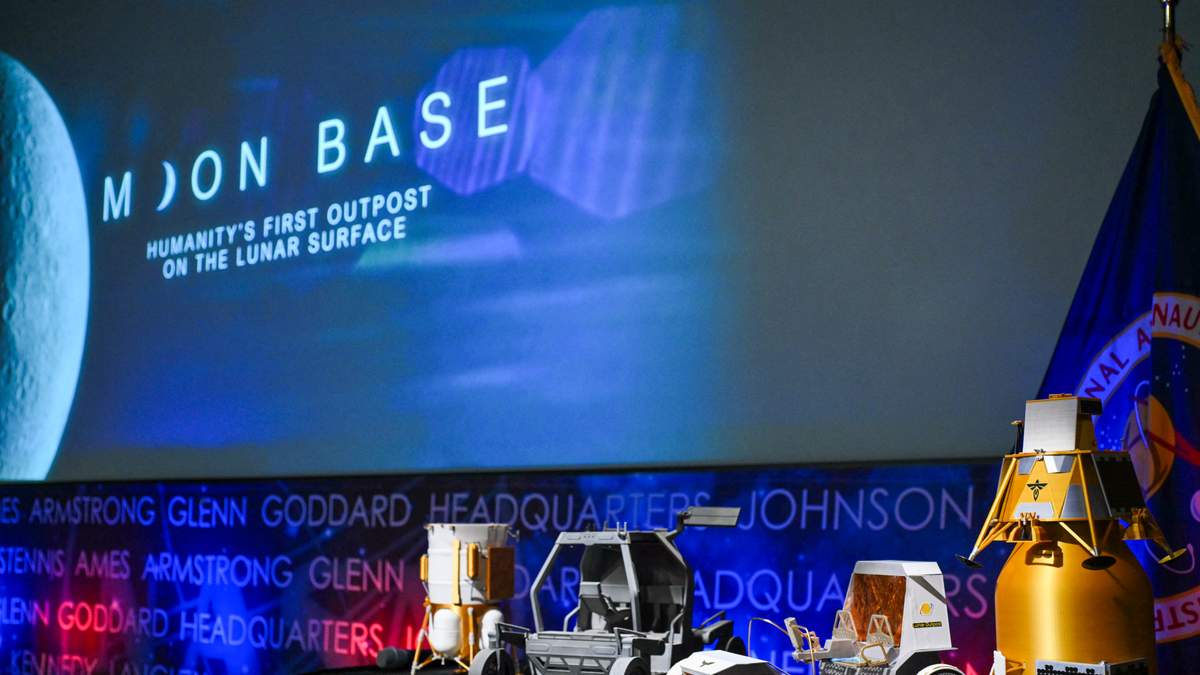

NASA has shared new details about its plans to build a permanent base near the moon’s south pole, with a target date of 2032 for a continuous human presence. The announcement comes just ahead of the 57th anniversary of the Apollo 11 landing, as agency leaders explained their three-phase approach to returning astronauts to the lunar surface and establishing a lasting outpost.
Jared Isaacman, NASA Administrator, and Carlos García-Galán, moon base program manager, said the U.S. is “making a lot of progress” toward building a lunar settlement. NASA plans to use robots, autonomous vehicles, and drones to map and study the challenging terrain and hazards of the lunar south pole before sending humans there.
Phase 1 of the project, already underway and running until 2029, focuses on robotic missions to test key technologies. NASA expects to conduct 25 rocket launches and 21 moon landings during this phase, partnering with companies like Blue Origin, Astrobotic, Firefly Aerospace, and Intuitive Machines to deliver science payloads and cargo. These contracts are worth nearly $600 million and are part of NASA’s Commercial Lunar Payload Services initiative.
Among the new technologies under consideration is PROMISE (Polar Rover for Observation, Mapping, and In-Situ Exploration), an engineering version of the Mars Perseverance rover. NASA is exploring whether PROMISE could be sent to the moon to help map the surface and search for resources. “We are thinking very hard right now about sending PROMISE to the moon. That would be an awesome capability,” Isaacman said, adding that the agency is still reviewing the idea’s feasibility.
Phase 2 begins in 2029 and shifts focus to assembling semi-permanent infrastructure, such as solar and nuclear power plants, upgraded rovers, expanded communication networks, and logistics for longer stays. NASA expects 27 rocket launches and 24 landings during this phase. By Phase 3, starting in 2032, the agency aims for a permanent crewed presence, with astronauts living and working at the moon base in rotation, similar to the International Space Station. This phase will include 29 launches and 28 landings.
The United States faces competition from China, which is aiming to land humans on the moon by 2030. NASA’s plans rely on successful development of new lunar landers by companies such as SpaceX and Blue Origin, but there have been delays, including damage to Blue Origin’s New Glenn rocket launch site.
NASA has budgeted $20 billion for the moon base, but some experts predict costs could rise. The Artemis III mission, scheduled for next year, will test new lunar landers in orbit, though it will not include a moon landing.
Despite challenges, Isaacman said, “We are in the business of the near impossible, so why not? I’m optimistic.” NASA officials emphasized that building the moon base will lay the groundwork for future Mars missions and sustained lunar research.
Recent Comments