
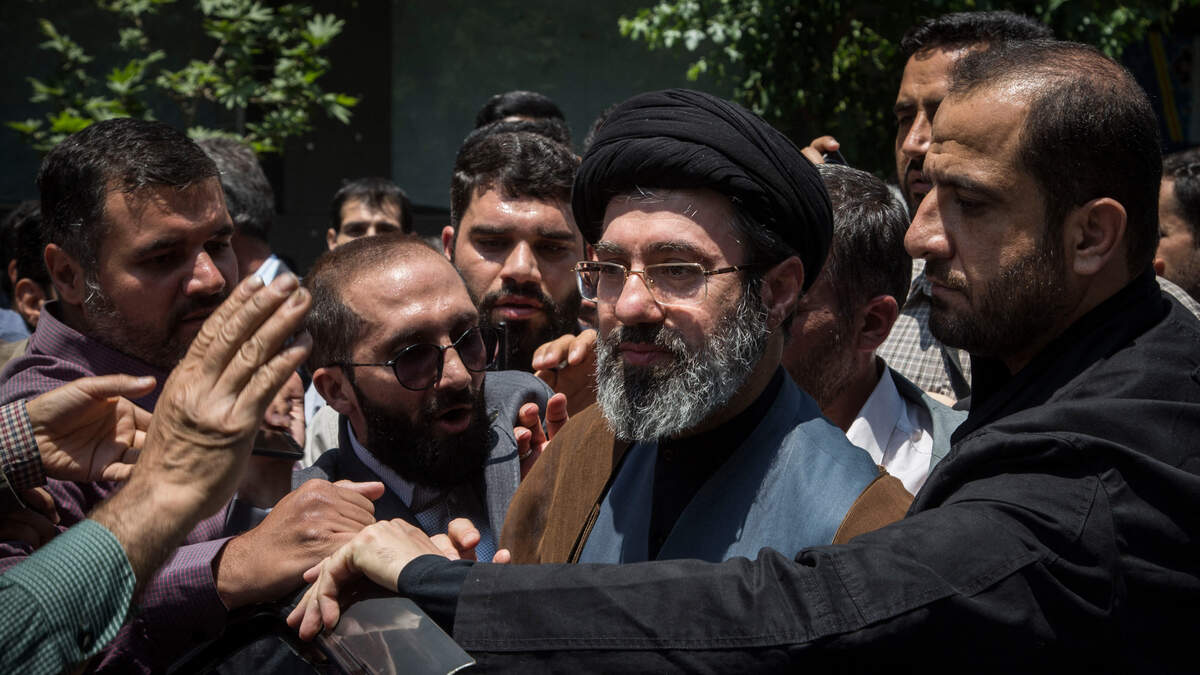

Iran’s newly appointed supreme leader, Mojtaba Khamenei, has issued his first public statement since taking power, vowing to keep the Strait of Hormuz closed and threatening revenge for strikes he blames on the United States and Israel — a declaration that sent fresh shockwaves through already volatile global energy markets.
Khamenei, 56, was elevated to the role of supreme leader after his father, Ayatollah Ali Khamenei, was killed in U.S. and Israeli strikes.
Speaking through Iran’s state television — which read a written statement while displaying a banner of his face — Khamenei said the blockade of the strategic waterway must continue. “Certainly, the lever of blocking the Strait of Hormuz should still be used,” he said.
The Strait of Hormuz carries roughly one-fifth of the world’s oil supply each year. Its effective closure since the U.S.-Israeli assault began on February 28 has sent crude oil prices swinging wildly — at one point surging past $120 a barrel before retreating below $100, only to creep back above $92 as of early Thursday (March 12) morning.
In his statement, Khamenei promised vengeance for a strike on the Shajareh Tayyebeh elementary school in Minab, which killed 170 people, most of them children. A U.S. military investigation has found that outdated intelligence likely led to the strike and that American ordnance was probably responsible. The school sits on a compound that was formerly used by the Islamic Revolutionary Guard Corps (IRGC) until about 15 years ago.
“I assure everyone that we will not abandon the pursuit of justice for the blood of your martyrs,” Khamenei said. He singled out the school strike as deserving “particular attention.”
Iran’s IRGC reinforced the supreme leader’s message with sharp language of its own. According to Al Jazeera, an IRGC spokesperson declared that not “a litre of oil” would pass through the strait and warned that any vessel linked to the U.S., Israel, or their allies “will be considered a legitimate target.” The spokesperson added, “Expect oil at $200 per barrel.”
President Donald Trump, meanwhile, appeared to downplay rising energy costs, posting on his Truth Social platform that “when oil prices go up, we make a lot of money.” He added that stopping Iran from obtaining nuclear weapons was his greater priority. Trump also encouraged commercial vessels to keep transiting the strait, saying, “I think you’re going to see great safety, and it’s going to be very, very quickly.”
The International Energy Agency (IEA) called the conflict “the largest supply disruption in the history of the global oil market” in its monthly report released Thursday (March 12). The agency coordinated a record release of 400 million barrels of oil from emergency reserves among its 32 member nations, but analysts say the move is only a temporary fix. Japan alone committed to releasing roughly 80 million barrels.
With the Strait of Hormuz still effectively shut and no diplomatic resolution in sight, energy experts warn that consumers and businesses worldwide should brace for continued market instability in the days and weeks ahead.
Recent Comments