
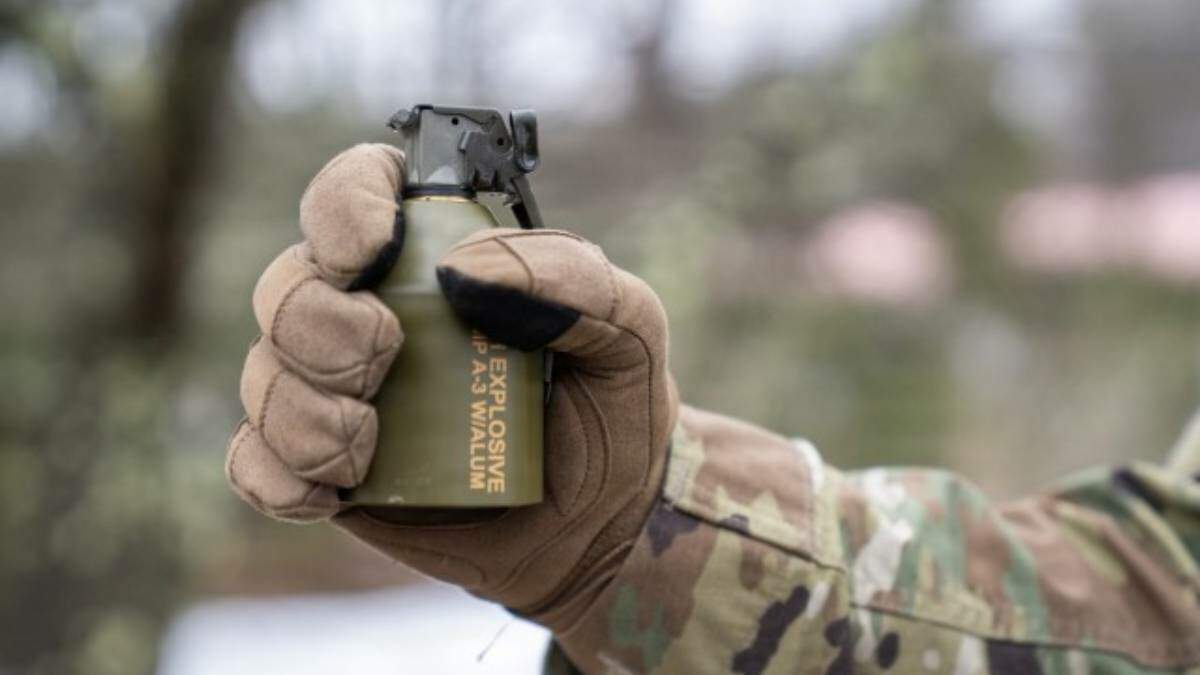

The U.S. Army has approved its first new lethal hand grenade since the Vietnam War era — a plastic weapon that uses shock waves instead of shrapnel to neutralize enemies in close-quarters combat.
According to the U.S. Army, the new M111 Offensive Hand Grenade (OHG) received full material release, marking the first new lethal grenade to enter service since 1968. Engineers at Picatinny Arsenal in New Jersey developed the weapon to give soldiers a more effective tool for urban combat, where traditional fragmentation grenades can be as dangerous to friendly troops as to the enemy.
For nearly six decades, the M67 fragmentation grenade — the round, baseball-shaped weapon soldiers have carried since Vietnam — served as the Army’s go-to hand grenade. The M67 works by sending steel fragments outward in all directions when it explodes. In open terrain, that’s highly effective. But inside buildings, those same fragments can bounce off walls, pierce thin barriers, and put friendly troops at risk.
The M111 takes a different approach. Instead of shrapnel, it uses blast overpressure (BOP) — a powerful wave of force created by the explosion. Unlike fragments, BOP can’t be stopped by interior walls, doorframes, or furniture, making it far more effective in enclosed spaces.
Col. Vince Morris, project manager for Close Combat Systems at the Capabilities Program Executive Ammunition and Energetics (CPE A&E), pointed to hard lessons learned in Iraq as the driving force behind the new weapon.
“One of the key lessons learned from the door-to-door urban fighting in Iraq was that the M67 grenade wasn’t always the right tool for the job,” Morris said. “The risk of fratricide on the other side of the wall was too high. But a grenade utilizing BOP can clear a room of enemy combatants quickly, leaving nowhere to hide while ensuring the safety of friendly forces.”
The M67 isn’t going away. The Army designed the two grenades to work as a pair — soldiers will use the M67 in open terrain to maximize lethal fragment effects, and the M111 in enclosed spaces to maximize BOP effects.
The transition is designed to be smooth. Both the M111 and the M67 use the same five-step arming process, and the M111 shares fuze components with the M67 and its training counterpart, the M69. That means soldiers switching between the two weapons won’t need to relearn how to use them — they train the same way they fight.
The shared fuze design also saves money. Morris explained that common production lines for both grenades’ fuzes allow the Army to cut costs through economies of scale, while government-owned intellectual property on both weapons enables competition across multiple vendors.
Recent Comments