
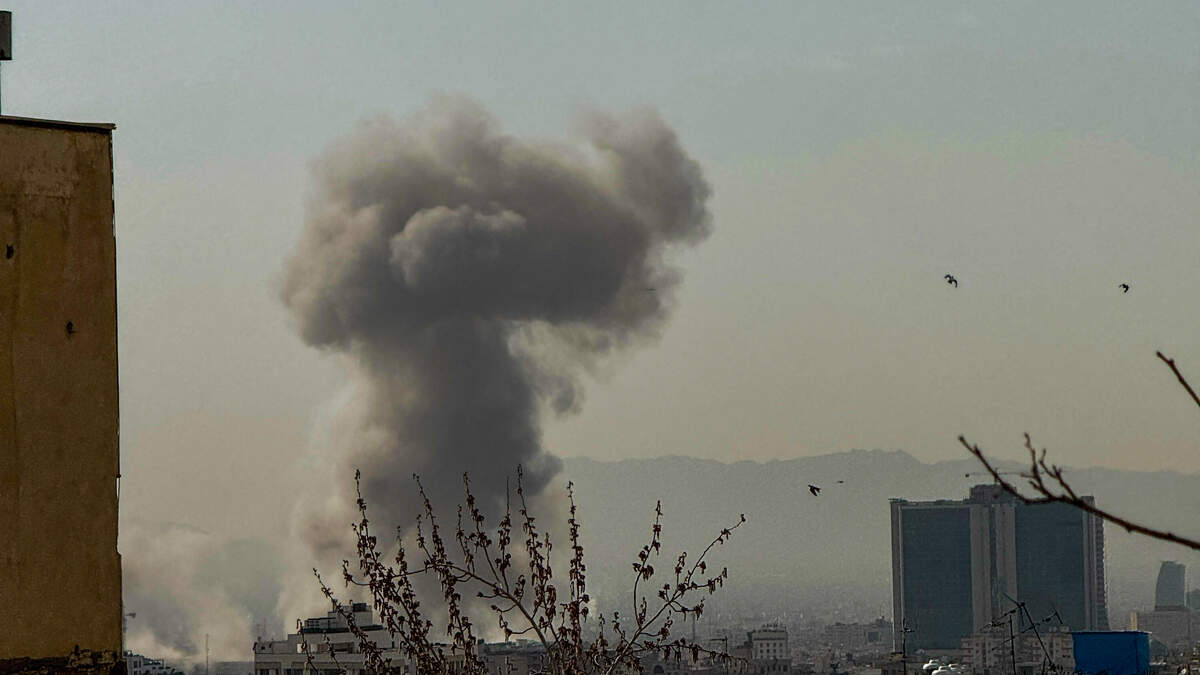

The United States and Israel launched military strikes against Iran early Saturday, with President Donald Trump confirming what he called “a massive and ongoing operation” to stop Iran from threatening American national security interests.
In a video posted to his Truth Social platform, President Trump said the U.S. was acting to prevent “this very wicked, radical dictatorship from threatening America and our core national security interests.”
The strikes mark a dramatic escalation of weeks of mounting tension between Washington and Tehran, capping a period of intense diplomatic pressure, military buildup, and failed negotiations over Iran’s nuclear program.
Secretary of State Marco Rubio had been scheduled to travel to Israel on Monday, according to Al Jazeera, with the trip focused on Iran, Lebanon, and President Trump’s 20-point plan for Gaza. That visit was announced just days before the strikes were carried out.
The road to Saturday’s strikes was paved with repeated threats from President Trump. Since January, the administration deployed what Trump described as a “massive armada” near Iran, including two aircraft carriers — the USS Gerald Ford and the USS Abraham Lincoln. During his State of the Union address last Tuesday, President Trump warned that he would “never hesitate to confront threats to America” and credited military threats with stopping Iran from executing protesters.
On Friday, just hours before the strikes began, President Trump told reporters on the White House lawn that he was frustrated with the pace of nuclear talks. “I’m not happy with the fact that they’re not willing to give us what we have to have,” he said. When asked about the prospect of military force, he added, “I’d love not to use it, but sometimes you have to.”
President Trump also made clear he would not accept any level of Iranian uranium enrichment. “I say no enrichment,” he told reporters. “Not 20 percent, 30 percent.”
The U.S. and Iran had been engaged in indirect nuclear negotiations brokered by Oman, with a third round of talks held this week in Switzerland. A fourth round was slated for Monday in Austria. U.S. envoys Steve Witkoff and Jared Kushner had been pressing for more time to pursue a diplomatic solution.
The Times of Israel reported that Israeli Prime Minister Benjamin Netanyahu had also been pushing for military action and left a recent meeting with President Trump uncertain of where the president stood, reportedly asking afterward whether Trump was “still with us.”
Iran said its position was “close” to the U.S. on many issues but called American demands — including dismantling its nuclear program, curbing its ballistic missile arsenal, and severing ties with regional proxy groups like Hezbollah — excessive and unrealistic.
In the days before the strikes, multiple U.S. outlets reported that Joint Chiefs of Staff Chairman Gen. Dan Caine had raised concerns within the Pentagon and National Security Council. Iran International reported that Caine warned President Trump about munitions shortfalls, the risk of a prolonged conflict, significant U.S. casualties, and limited allied backing.
President Trump pushed back hard on those reports. “Numerous stories from the Fake News Media have been circulating stating that General Daniel Caine is against us going to War with Iran,” he wrote on Truth Social on February 23. “The story is 100% incorrect.”
President Trump added that Caine “only knows one thing, how to WIN and, if he is told to do so, he will be leading the pack.”
The strikes come in the wake of a brutal crackdown by Iran’s government on anti-regime protests that swept the country in January. Iran’s government officially claimed around 3,000 Iranians died during the unrest. But human rights groups and the United Nations special rapporteur on Iran said the death toll could reach into the tens of thousands, according to Iran International.
The U.N. High Commissioner for Human Rights Volker Turk warned on Friday (February 27) that eight protesters have been sentenced to death, and 30 more face the same penalty. Turk also cautioned against military escalation, saying, “I am extremely alarmed about the potential for regional military escalation and its impact on civilians, and I hope the voice of reason prevails.”
Alongside the crackdown, Tehran launched a sophisticated online information campaign framing the protests as a CIA–Mossad operation. Researchers at Rutgers University’s Network Contagion Research Institute tracked that narrative across more than 300 social media accounts, finding millions of views for posts that amplified Iranian state propaganda.
Adding urgency to the situation, the International Atomic Energy Agency (IAEA) said it had been blocked from accessing the three Iranian nuclear sites hit during last June’s Operation Midnight Hammer — a U.S.-Israeli campaign that struck the Fordow facility and two others. The IAEA said it could not confirm whether Iran had suspended enrichment at those sites, nor estimate the size of Iran’s nuclear stockpile.
The full scope and results of Saturday’s strikes remain unclear. As the operation unfolds, attention will turn to how Iran responds, whether regional allies are drawn into the conflict, and what path — if any — remains open for diplomacy.
Recent Comments