
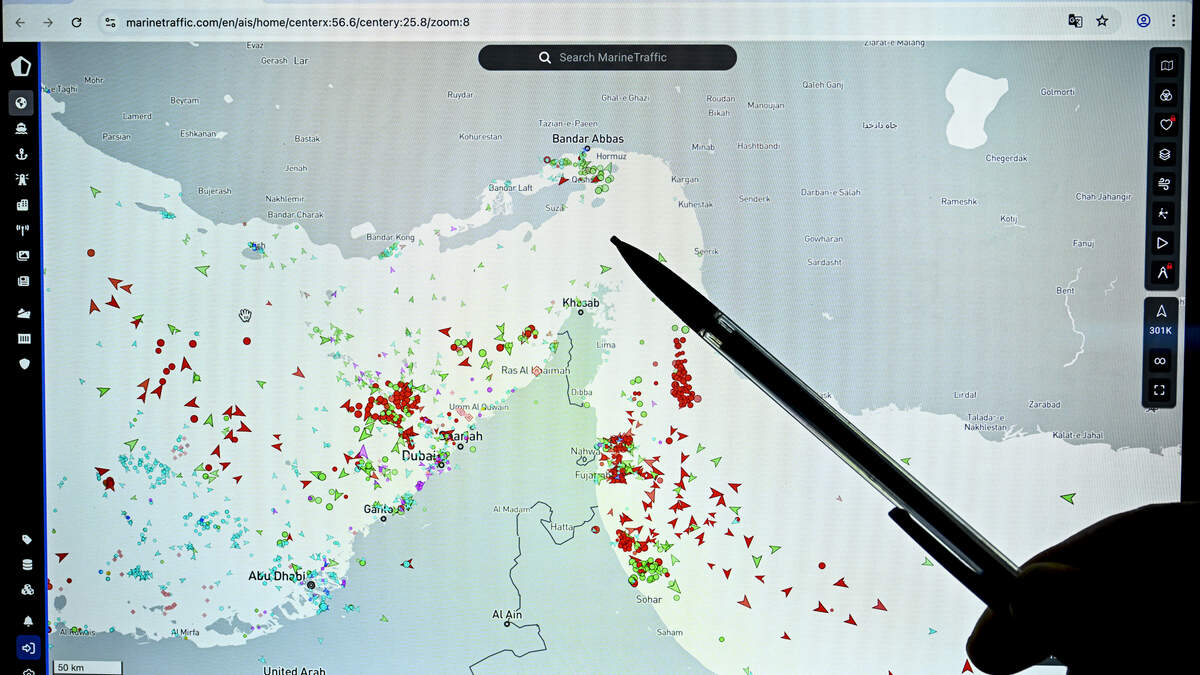

Global shipping through the Strait of Hormuz has ground to a near-standstill following U.S. and Israeli strikes on Iran over the weekend, triggering a cascade of disruptions that analysts warn could ripple through the world economy for weeks to come.
The strait — just about 21 miles wide at its narrowest point, sitting between Iran and Oman — is one of the most critical energy corridors on the planet. According to the U.S. Energy Information Administration, oil flows through the waterway averaged 20.9 million barrels per day in 2023, accounting for roughly 20% of global petroleum liquids consumption. The strait also handles about 20% of global liquefied natural gas (LNG) shipments.
The disruption is being driven not only by Iranian threats to close the waterway, but by the very real danger of missile and drone strikes in the narrow corridor. “You’ve essentially had the Strait of Hormuz grind down to a halt,” said Matt Smith, an analyst at Kpler, a data and analytics firm, according to Fox News. He added that a growing bottleneck of crude and refined products is forming, and warned: “If this drags on for weeks, the ramifications are huge.”
In response to the escalating threat, Danish shipping giant Maersk announced it would suspend all vessel crossings through the Strait of Hormuz until further notice, warning that ports in the Arabian Gulf could face significant delays. German shipping firm Hapag-Lloyd and France’s CMA CGM followed suit, both halting transits and rerouting ships around the Cape of Good Hope at the southern tip of Africa. MSC, the world’s largest container shipping company, ordered all vessels in the Gulf region to proceed to designated safe areas.
The disruptions extend beyond the Strait of Hormuz. Maersk also paused trans-Suez sailings through the Bab el-Mandeb Strait — a narrow chokepoint linking the Red Sea to the Gulf of Aden — which in 2023 accounted for 12% of seaborne oil trade and 8% of global LNG trade.
Maritime insurers are also pulling back. Major firms including Gard, Skuld, NorthStandard, the London P&I Club, and the American Club announced they will cancel war-risk coverage this week for Iranian waters and the broader Gulf region, adding another layer of uncertainty for shippers.
The fallout is already hitting energy production. Qatar halted LNG output after Iran struck two of its gas facilities, and Qatar has also declared force majeure — a formal notice to buyers that it may not be able to fulfill export commitments due to the conflict. Saudi Arabia suspended operations at its largest oil refinery following an Iranian drone attack that sparked a fire. Iraq has begun curbing output, and some Asian refineries are cutting production runs.
Peter Sand, chief analyst at Xeneta, told CNBC’s Squawk Box Europe that higher container shipping rates should be expected for the Middle East region for as long as the conflict continues. “The risk of geopolitics has shown its ugly face with higher frequency and more severity over the past years than ever before,” Sand said.
Adding to the concern, analysts warn that disruptions to fertilizer supply chains moving through the region could affect U.S. farmers who rely on those inputs for major crops like corn, soybeans, wheat, and cotton.
President Trump said on Truth Social that the U.S. will “immediately” offer “political risk insurance and guarantees” for energy tankers and other ships operating in the Gulf region, and that the Navy would escort tankers through the Strait of Hormuz if needed.
Recent Comments