
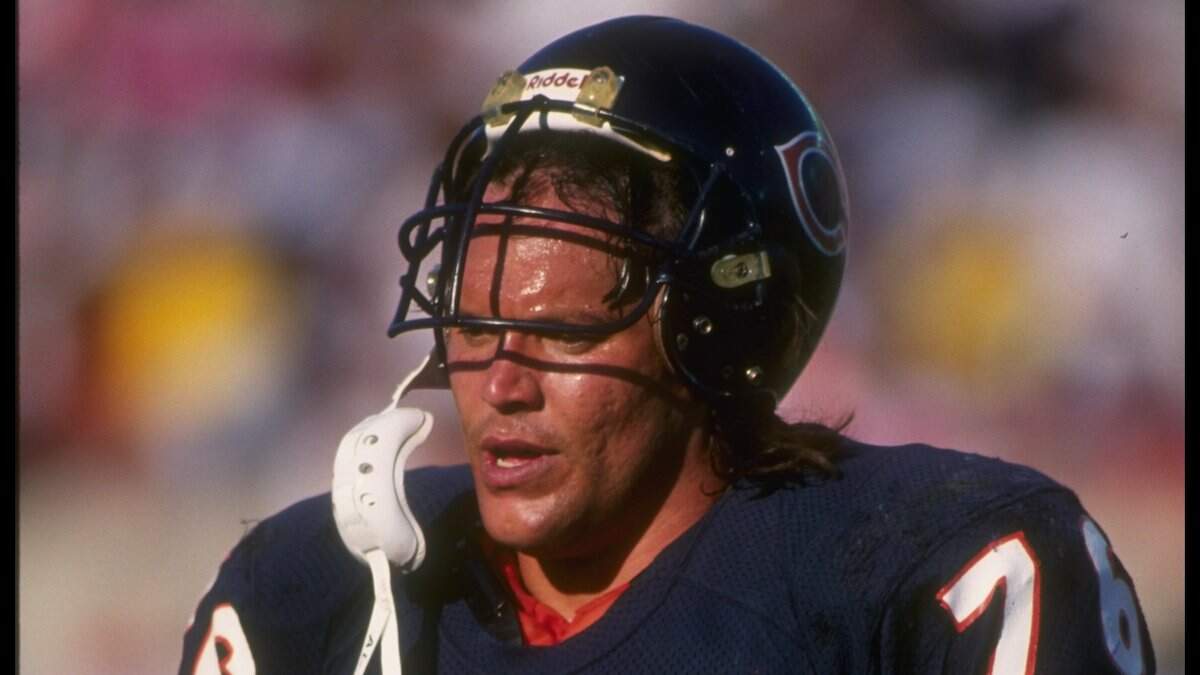

Pro Football Hall of Famer Steve ‘Mongo‘ McMichael was diagnosed with chronic traumatic encephalopathy one year after his death, the Concussion & CTE Foundation said via the Associated Press.
McMichael, who spent the majority of his NFL career with the Chicago Bears and was a member of the 1985 Super Bowl XX team, died at the age of 67 last April following a five-year battle with ALS.
“Too many NFL players are developing ALS during life and diagnosed with CTE after death,” his wife, Misty McMichael, said in a statement released by the Concussion & Cte Foundation. “I donated Steve’s brain to inspire new research into the link between them.”
McMichael was a mainstay on the Bears’ defense for 13 of his 15 NFL seasons, which included winning Super Bowl XX, after spending his first season with the New England Patriots in 1980 and final season with the Green Bay Packers in 1994. The Houston native made two Pro Bowl appearances (1986, 1987), received two First-team All-Pro nominations (1985, 1987), three Second-team All-Pro nominations (1986, 1988, 1991) and was named to the Pro-Football-Reference 1980’s All-Decade Team, as well as the 100 Greatest Bears list celebrating the franchise’s centennial anniversary in 2019.
McMichael was inducted into both the Pro Football Hall of Fame College Football Hall of Fame and worked as the head coach of the Chicago Slaughter from 2007-2013, which included winning a CIFL championship in 2009. The former University of Texas standout also enjoyed a notable post-football career in professional wrestling, first appearing in the corner of Pro Football Hall of Famer Lawrence Taylor for his then-WWF WrestleMania XI main event match against Bam Bam Bigelow.
Medical studies in recent years show that athletes, primarily football players, have a high risk of CTE, a degenerative brain disease, which includes a 2023 Boston University CTE Center study examining 152 donated brains that showed more than 40% of youth, high school and college athletes who were exposed to repetitive head impacts from contact sports and died before the age of 30 were diagnosed with CTE, according to ESPN.
Former NFL players Junior Seau, Conrad Dobler and Dave Duerson were all diagnosed with CTE after their deaths. CTE cannot be diagnosed with certainty among living people as it can only be confirmed through an autopsy in which specialists study specific changes in the brain, however, doctors can suspect it based on symptoms and past head trauma.
Symptoms of CTE include memory loss, mood changes, confusion and trouble thinking clearly among patients.
Recent Comments