
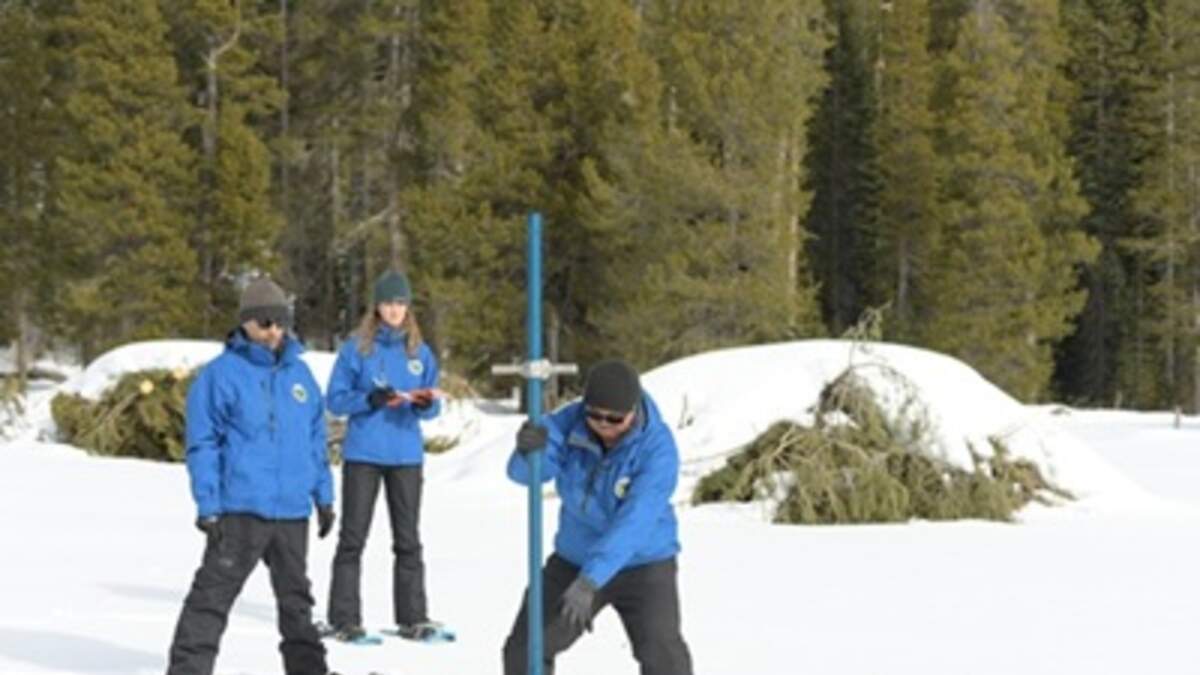

April 1 is typically the peak of California’s snow season — the day the Sierra Nevada snowpack reaches its greatest depth of the year. This year, there’s almost nothing left to measure.
A record-breaking heat wave has scorched California throughout March, causing the Sierra snowpack to collapse to just 35% of its April 1 average, according to CalMatters. The snowpack has been shrinking by more than one percentage point every day — a rate that has alarmed state water officials, climate scientists, and ski resort operators alike.
Andrew Schwartz, director of UC Berkeley’s Central Sierra Snow Lab, said his station northwest of Lake Tahoe has been losing “about 8% to 13% of our snowpack per day.” He called this winter “ridiculously warm” and described the Sierra Nevada as being in the middle of “a warm snow drought.” Schwartz said the season reflects what’s coming. “This year represents what climate change will be showing us in the decades to come,” he said.
Christopher Johnston, a meteorologist with the National Weather Service’s Reno office, told KQED that South Lake Tahoe shattered its all-time March temperature record, hitting 76 degrees — five degrees warmer than the previous record set in 2015. Johnston said temperatures may dip slightly on weekends, but the heat could rebuild as soon as early next week. “We might flirt with record highs again next week,” he said.
Benjamin Hatchett, an earth system scientist at Colorado State University, has a name for what California just experienced: a “snow-eater heat wave.” His research shows these events can double snowmelt rates and typically last up to five days. As human-driven climate change worsens, he said, these heat waves are growing in scale and arriving earlier each season. “This heat wave is a textbook example of a snow-eater heat wave,” Hatchett said. “It’s something that we should expect, and when snow-eater heat waves happen, they’re going to be worse.”
The snowpack is not uniform across the range. The northern Sierra sits at just 18% of its April 1 average, the central Sierra at 40%, and the southern Sierra at 57% of normal, according to KQED.
State climatologist Michael Anderson said this year’s snowpack is rapidly approaching the worst five ever recorded for April 1, and is likely to keep falling. Still, Anderson said California’s reservoirs are in generally good shape, brimming above historic averages with many nearing capacity. He described the season as “playing out pretty much as we expect in a warmer world,” pointing to human-caused climate change as the driver of fewer but more intense warm storms that melt snow instead of adding to it. “This year fits that bill,” Anderson said.
Willie Whittlesey, general manager of the Yuba Water Agency, said conditions near New Bullards Bar reservoir are unlike anything typical for this time of year. “We’re seeing snowmelt conditions in mid-March that we normally don’t see until at least mid-May,” he said. “It’s just happening about two months early.” The agency is currently working with the U.S. Army Corps of Engineers to update decades-old federal rules that limit how much water can be stored in the reservoir before June.
In the Bay Area, the East Bay Municipal Utility District is working to hold on to every available drop. Spokesperson Andrea Pook said the district is reducing releases from its reservoirs to preserve water for the fall salmon migration season. “The last time that we had runoff this early was in 2015,” Pook said. She added, “I am not convinced that we’re going to fill our reservoirs by July 1, which is our usual goal.”
Water experts are also looking for creative solutions. Newsha Ajami, founding director of the Risk Resilience Recovery Program at Stanford’s Doerr School of Sustainability, suggested exploring groundwater storage. “Can we store some of the water we’ve released from the reservoirs that might not be needed right now in different formats, like groundwater basins?” she said. “So then later, if the reservoir levels go down, we can tap into that water source.”
The early melt is also raising fire risk. Schwartz said forests now have an extra month and a half of drying time heading into summer. “I think most of us anticipate kind of a rough fire year,” he said. “We’re going to have drier fuels for fires as we go into the summer.”
Despite improved forecasting tools, Anderson said permitting delays at the U.S. Forest Service — which has shed thousands of employees under President Donald Trump — are slowing efforts to install additional soil moisture sensors in national forests. “You wait in line a lot longer,” he said. “That’s been the biggest limitation of late. There just isn’t anybody there.”
Looking ahead, Schwartz expects California’s drought map to start showing dry conditions in yellow, orange, and red across the range as spring turns to summer. “Even if it’s a little bit of creep on that drought index map, it’s going to happen,” he said.
Recent Comments