
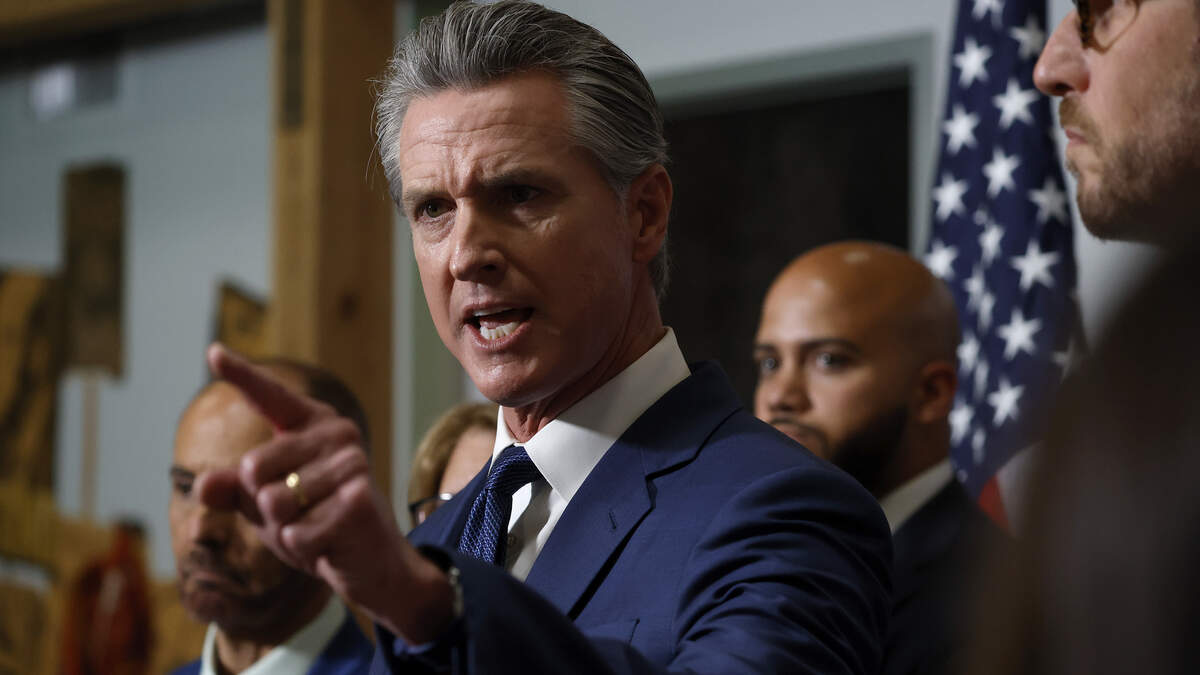

Gov. Gavin Newsom is threatening to strip state funding from 10 California counties he says aren’t doing enough to make his signature mental health court program work — and he’s naming names.
Speaking Monday at a news conference in Alameda County, Newsom called out Los Angeles, Orange, San Francisco, Santa Clara, San Bernardino, Kern, Riverside, Yolo, Monterey, and Fresno counties for falling short on his Community Assistance, Recovery and Empowerment (CARE) Court program. He launched the initiative in 2023 to use the court system to get people with severe mental illness into treatment.
“I’m happy to redirect every damn penny in these programs to the counties that are getting things done, period, full stop,” Newsom told reporters. “Unless they stop doing what they’ve done. Don’t make any more excuses.”
The governor labeled the 10 counties a “CARE ICU,” while praising Alameda, Humboldt, Santa Barbara, Tuolumne, Marin, Napa, Merced, Sutter, San Mateo, and Imperial counties as “CARE champions.” He spoke from inside an under-construction wing of Regis Village in Alameda, a mental health campus with 44 beds set aside for CARE Court participants.
Kim Johnson, secretary of the California Health and Human Services Agency, said the state has received 3,817 petitions for care on behalf of people with mental illness since the program launched. Judges have approved just 893 treatment agreements, and only 32 people have been ordered into CARE plans under a court order.
Newsom’s administration had originally projected that between 7,000 and 12,000 Californians would qualify for CARE Court. A CalMatters investigation found the program has served far fewer people than anticipated, with families and advocates expressing disappointment over its limited reach.
The governor set a benchmark of 6.2 petitions per 100,000 residents for successful implementation, ranking the 10 lowest-performing counties by that measure. However, critics say that metric doesn’t capture the full picture. According to the Sacramento Bee, San Diego County didn’t make the champions list even though it had the most CARE Court graduations in the state as of last summer.
Michelle Doty Cabrera, executive director of the County Behavioral Health Directors Association, pushed back on the metric. “The idea of measuring success on the numbers of people who are in need in any given community fails to account for those counties who may have already done an excellent job of connecting individuals with care that prevented them from falling into crisis,” she said in a statement.
Several counties disputed Newsom’s characterization. Orange County’s Health Care Agency said it is “utilizing the CARE intervention fully,” noting it has the fifth-highest number of petitions in the state and 79 participants currently receiving housing, medication, and other services. Santa Clara County Executive James Williams said his county has been at the “forefront” of expanding treatment and housing, and warned that reducing a complex system to “a single scorecard” misses the point.
San Francisco’s Mayor Daniel Lurie’s spokesperson, Charles Lutvak, said the city welcomes state support but defended its record. “Today, encampments are at record lows, more people are getting connected to shelter and treatment, and San Franciscans feel safer than they have in years,” Lutvak wrote in a statement.
The San Francisco case carries added weight after the San Francisco Chronicle reported on the death of Connor Keith, a 35-year-old San Francisco man who died of an overdose just 10 days after a judge dismissed his CARE Court case. His mother had filed the petition hoping to get him help after he became homeless following a relapse during the COVID-19 pandemic.
Johnson said Keith’s story “certainly had an impact” on her agency. “That kind of tragedy is something that we’re going to pay attention to and really try to understand and unpack where things could have happened differently and where it can be done better,” she said.
More than 4,000 people who were initially referred to CARE Court were redirected into other services, Johnson noted. However, the state does not yet have data on whether those people stayed in treatment or housing long-term.
Newsom announced $131.8 million in Homekey+ awards, funded by Proposition 1, to create 443 homes for people needing mental health and substance use services. He also rolled out $159 million in Homeless Housing, Assistance and Prevention dollars — part of $1 billion allocated in the 2024–25 budget — though three of the “CARE ICU” counties, San Bernardino, Monterey, and Fresno, are among the recipients of those new funds.
Newsom said he may seek to redirect CARE Court funding through his revised state budget proposal in May, which would require approval by the state Legislature.
Recent Comments