
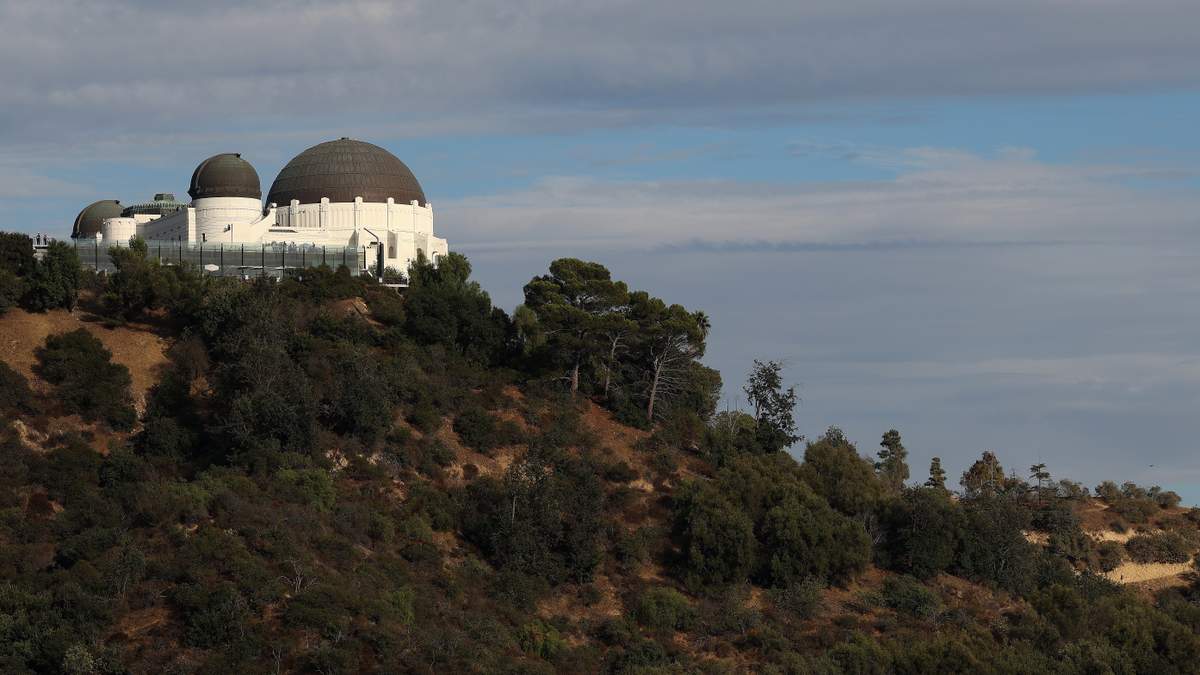

LOS ANGELES (CNS) – The Los Angeles Astronomical Society’s celebration of its 100th anniversary Saturday at the Griffith Observatory will be highlighted by an evening observation from 7:30 p.m. to 9:30 p.m. where members will place 100 telescopes on the lawn to represent 100 years.
Participants will be shown how to use a telescope and stargaze.
There’s going to be “a lot of love,” society President Keith Armstrong said.
The event will begin at 5 p.m. with presentations of proclamations from Hannah Jaeger, a field deputy for Councilmember Nithya Raman, whose Fourth District includes Griffith Park, Monterey Park Mayor Elizabeth Yang, and Brendan Hidalgo, an assistant field deputy for Los Angeles County Supervisor Kathryn Barger.
E. C. Krupp, the director of the Griffith Observatory since 1974, will present a centennial plaque.
Armstrong described the society as a social club with a penchant for astronomy, with members coming from all walks of life. The society describes its mission as promoting interest in and advancing the knowledge of astronomy, optics, telescope making and related subjects.
The society was founded in 1926 by 30 local amateur telescope makers as the Los Angeles Telescope Makers Society. It is the second oldest club of its type in the nation after the Springfield (Vermont) Telescope Makers, which was founded in 1923.
It was incorporated as a not-for-profit corporation in 1929, became the Amateur Astronomical Society of Los Angeles in 1934 and the Los Angeles Astronomical Society in 1949.
The society began using its Lockwood Valley dark sky site near Frazier Park in 1970. Since 1987, the society has also operated the Garvey Ranch Park Observatory and its telescope-making workshop in Monterey Park, where it hosts events Wednesday nights from 7:30 p.m. to 10 p.m.
It also conducts Starparty Silverlake at Sunset Triangle Plaza at 3700 Sunset Blvd. Thursdays from 8 p.m. to 10:30 p.m.
Armstrong told City News Service that Los Angeles has a rich history of astronomical discovery and space exploration.
In 1919, astronomer Edwin Hubble arrived at Mount Wilson Observatory the same year the Hooker Telescope — the world’s largest telescope at the time — was roughly completed. During his time at Mount Wilson, Hubble found the Andromeda Nebula and Triangulum Nebula. The nebulae were later discovered to be entire galaxies outside the Milky Way.
Hubble used his observations to measure distance between galaxies, and developed a theory that the universe was expanding.
“We’ve always been part of space exploration and discovery,” Armstrong said. “We still have the Jet Propulsion Laboratory, Carnegie Observatory. There’s a ton of aerospace happening here. The space shuttle was built partially here.
“We’ve always been part of space exploration and discovery, and still are.”
Recent Comments