
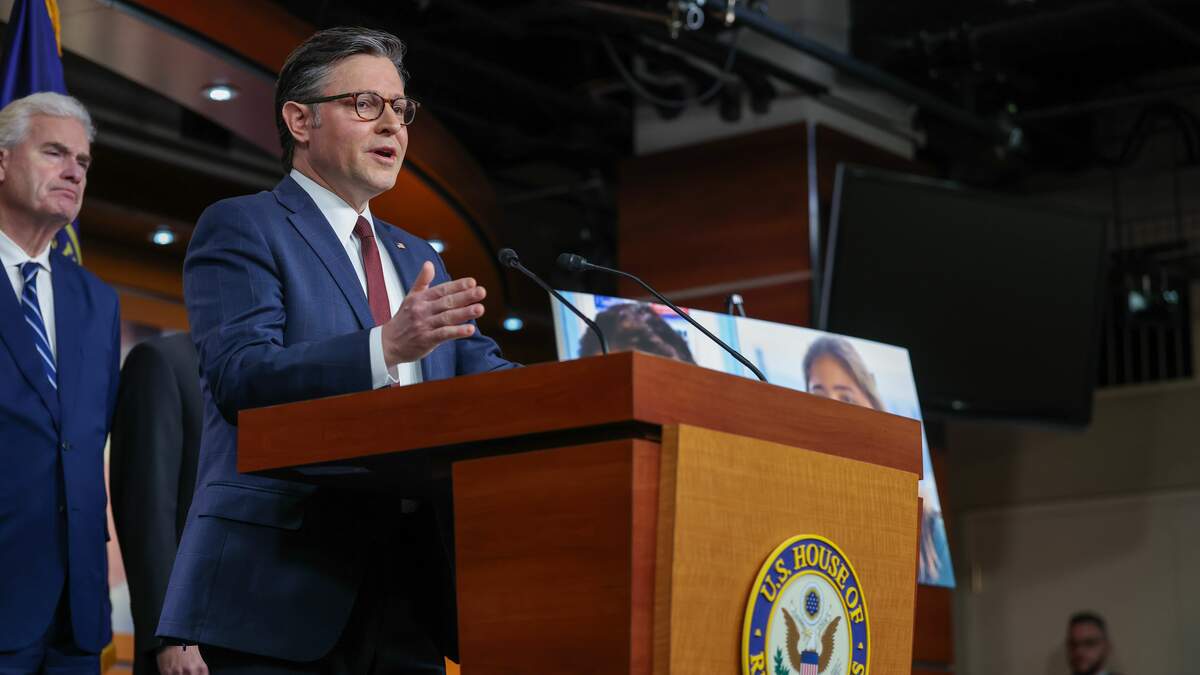

The House passed a Republican-backed bill Friday (March 28) to fund the entire Department of Homeland Security (DHS) for eight weeks, but the measure faces a near-certain dead end in the Senate, where Democrats say they will not support it. The House vote was 213-203.
The bill would extend DHS funding through May 22, covering all agencies, including Immigration and Customs Enforcement (ICE) and Customs and Border Protection (CBP). Three Democrats broke with their party to support the measure: Reps. Henry Cuellar of Texas, Don Davis of North Carolina, and Marie Gluesenkamp Perez of Washington.
Senate Minority Leader Chuck Schumer wasted no time in declaring the House bill finished before it even arrives in the upper chamber. “A 60-day CR that locks in the status quo is dead on arrival in the Senate, and Republicans know it,” Schumer said. Because the bill would need 60 votes to clear a Senate filibuster, Democrats hold the power to block it.
The House vote came after a chaotic day on Capitol Hill. Early Friday (March 28), the Senate passed its own DHS funding bill by unanimous consent — a rare bipartisan move. That measure would have funded most of DHS, including the Transportation Security Administration (TSA), the Coast Guard, the Federal Emergency Management Agency (FEMA), and the Cybersecurity and Infrastructure Security Agency (CISA), but it deliberately left out ICE and parts of CBP.
Democrats demanded the ICE and CBP carveout following the fatal shootings of two American citizens in Minneapolis by federal immigration agents earlier this year. They have repeatedly called for reforms to ICE’s operations before agreeing to restore that agency’s funding.
House Speaker Mike Johnson rejected the Senate bill outright, calling it “a joke.” Members of the House Freedom Caucus, led by Chair Andy Harris of Maryland, backed him up, demanding full ICE and CBP funding as well as a new voter ID requirement championed by President Trump. “The only thing we’re going to support is adding that funding into the bill, adding voter ID, sending it back to the Senate,” Harris told reporters.
The partial DHS shutdown hit Day 42 on Friday (March 28), and with both chambers now heading into a two-week spring recess, it is on track to become the longest in history. The Senate is not scheduled to return until Monday, April 13, and the House until Tuesday, April 14.
The shutdown has hit the TSA especially hard. Nearly 500 TSA employees have quit since the shutdown began on February 14, and thousands more have called out of work, triggering hours-long security lines at major airports across the country, including in Baltimore, Houston, New York, and Atlanta.
Baltimore/Washington International Thurgood Marshall Airport, located about 30 miles from Capitol Hill, urged weekend travelers to arrive four hours before their scheduled departures, saying it had “not previously experienced checkpoint wait times” like those seen this weekend.
President Trump signed a presidential memorandum Friday (March 28) directing DHS Secretary Markwayne Mullin to pay TSA employees, with DHS saying workers should begin seeing paychecks on Monday (March 30). However, union officials noted confusion about how long those payments could continue without a formal congressional funding agreement. “I think one of the questions from the workforce is, ‘Well, is this temporary, or is TSA fully funded now?'” said Johnny Jones, secretary-treasurer of the American Federation of Government Employees’ (AFGE) TSA Council 100.
Even if the shutdown ends soon, union leaders warned it could take days or weeks for airport staffing and security lines to return to normal levels.
Senate Republicans have signaled they plan to pursue additional ICE and CBP funding later in the year through the budget reconciliation process, a legislative tool that would allow them to bypass Democratic opposition entirely.
Recent Comments