
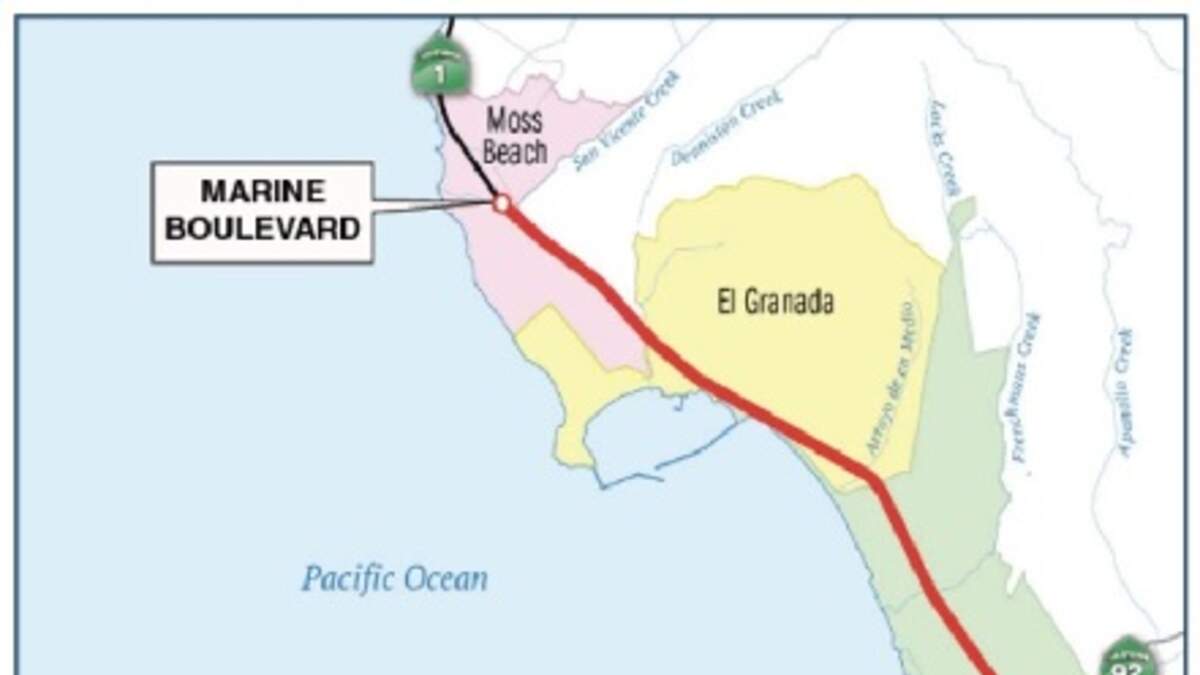

California transportation officials are considering moving a half-mile stretch of Highway 1 inland to address the disappearing shoreline at Surfers Beach near Half Moon Bay.
The proposal, which would relocate the highway about 200 feet inland and elevate it 22 feet, has caught local officials by surprise and raised significant concerns.
The plan would move the iconic coastal highway through the site of a planned 6-acre community park in El Granada, a coastal community of about 5,500 residents. According to reporting from the San Francisco Chronicle, the elevated roadway would cut through an area surrounded by apartment buildings, schools, and a busy post office.
Nancy Marsh, who serves on boards overseeing local wastewater treatment and parks, expressed concern that the proposal doesn’t account for existing infrastructure. “Right now they have a concept. The main concern is there’s public infrastructure in the way of that concept,” Marsh said.
The highway relocation is just one of several solutions Caltrans is considering for the eroding shoreline. The agency sent the study to the California Coastal Commission in November as part of a permit process, though it hasn’t yet undergone public comment.
“Further refinement of the scenarios will be conducted by Caltrans with input from various stakeholders,” said Jeneane Crawford, Caltrans’ public information officer, noting that no final decision has been made.
The situation at Surfers Beach highlights California’s broader challenge of protecting coastal infrastructure from climate change impacts. The beach has been disappearing largely because sand that would naturally drift down the shoreline has been cut off by Pillar Point Harbor to the north.
Other options being considered include building a bridge to elevate the roadway near its current position or continuing to add dredged sand to the beach. The Harbor District recently completed a $6.5 million sand replenishment project, but Caltrans notes this would need to be repeated every few years and isn’t a long-term solution on its own.
Barbara Dye, president of the Granada Community Services District board, hopes alternatives can be found. “Highway 1 is vital to this community,” she said, expressing hope for solutions that would “obviate the requirement to move the road inland for the foreseeable future.”
The project development process typically takes five to 10 years once studies are complete, according to Joshua Smith, public information officer for the Coastal Commission.
Caltrans has successfully implemented similar “retreat” strategies elsewhere along Highway 1, including a $60.5 million project at Gleason Beach near Bodega Bay, where it moved a section of highway 400 feet inland in 2023.
Recent Comments