
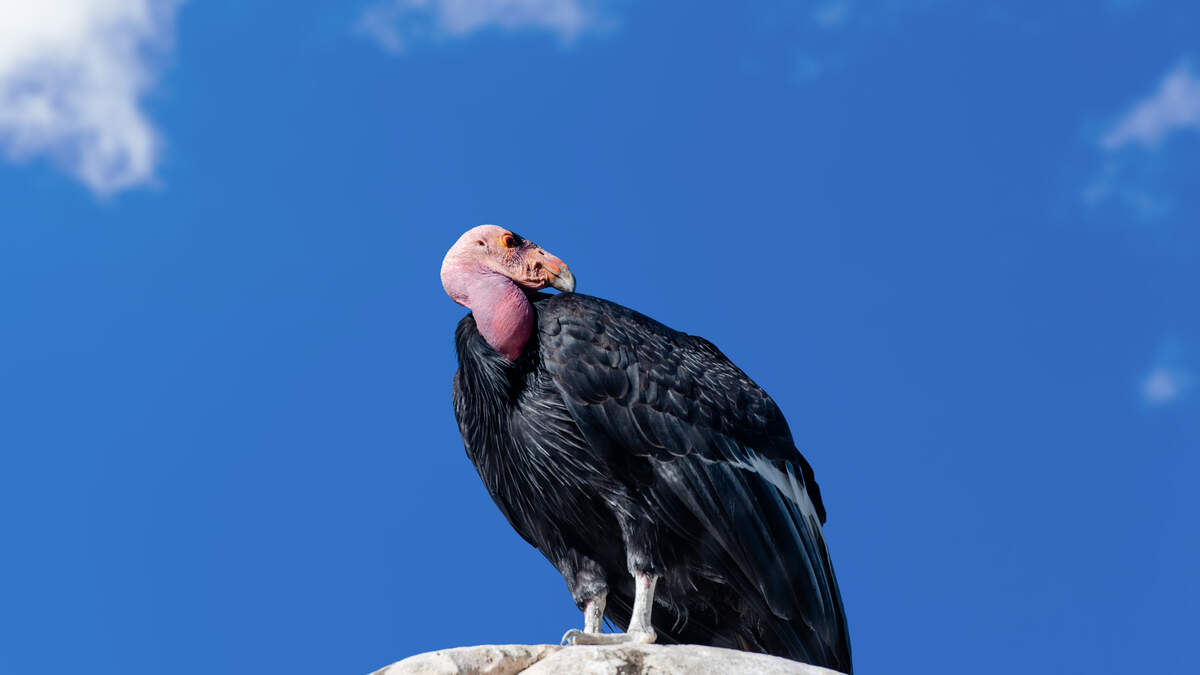

A major milestone in wildlife conservation is unfolding in the forests of far Northern California, where scientists believe a pair of endangered California condors has laid the region’s first egg in more than 100 years.
According to the San Francisco Chronicle, scientists with the Yurok Tribe’s wildlife department say two of the 26 condors released into the wild in Humboldt County since 2022 have paired up, built a nest high inside an old-growth redwood tree, and appear to be tending to a newly laid egg. The nest is located in a remote area within the Redwood Creek drainage in Redwood National and State Parks.
The birds — known as A0, or Ney-gem’ ‘Ne-chween-kah (“She carries our prayers”), and A1, or Hlow Hoo-let (“At last I fly!”) — are both 6 years and 10 months old. They were among the very first condors set free as part of the Northern California Condor Restoration Program (NCCRP). Scientists believe the egg was laid in early February.
“This is a huge moment for our Northern California flock,” said Chris West, the NCCRP manager and senior biologist with the Yurok Wildlife Department. “It feels kind of like we’ve been putting the birds out there and putting things in motion. But this is where they really take it upon themselves to take the strides needed to become a truly wild population.”
Because the nesting site is so remote, scientists cannot directly confirm the egg’s existence. Instead, they’re relying on GPS tracking data and behavioral clues. The two birds have been observed alternating between short flights and long, motionless periods at the tree — so still that their tracking tags triggered mortality alerts. As reported by the Lost Coast Outpost, researchers say those behavior patterns are consistent with biparental incubation, where both the male and female take turns keeping the egg warm.
“As soon as we looked at the GPS data closely, we said this is what we’re seeing for sure,” West said. “There really isn’t anything else this could be.”
The egg, estimated to weigh about 10 ounces and described as light blue in color, will need roughly 55 to 58 days to incubate. The NCCRP is also exploring the use of a drone to try to get a visual confirmation of the nest without disturbing the birds.
Scientists are cautiously optimistic. First-time condor parents often lack the experience needed to successfully raise a chick, and early eggs from new breeding pairs frequently don’t survive. Still, the nest represents a hopeful sign that the reintroduced flock is beginning to act like a truly self-sustaining wild population.
“I have been waiting for this moment since the first condors arrived in 2022,” said Tiana Williams-Claussen, director of the Yurok Wildlife Department. “As a scientist, I know I shouldn’t get my hopes up too high, but that doesn’t mean I can’t cheer for these young parents’ success.”
Ney-gem’ ‘Ne-chween-kah was bred at the Oregon Zoo and is the only female from the NCCRP’s first release group. Hlow Hoo-let was bred at the World Center for Birds of Prey. Both birds have been flying free since 2022.
The Yurok Tribe’s press release, republished by Earth Hope, notes that condors are slow to reproduce. Females lay only one egg at a time and typically nest every other year. Young condors take months to learn to fly and depend on their parents for more than a year. The birds generally reach sexual maturity around age six and can live more than 50 years.
California condors are North America’s largest flying birds, with wingspans of nearly 10 feet. Once common across the West Coast and beyond, they were nearly wiped out by a combination of habitat loss, power line collisions, hunting, and lead poisoning. As scavengers, condors can ingest lead fragments when they feed on animals killed with lead ammunition. By the 1980s, the wild condor population had fallen to just 22 birds. Federal biologists intervened with a captive breeding program that has slowly brought the species back from the brink. Today, roughly 300 condors live in the wild, with most located in Southern California and the Big Sur area.
The NCCRP, a partnership between the Yurok Tribe and Redwood National and State Parks, has released 26 condors in the Humboldt County area since 2022. Two of those birds have died; 24 are believed to still be living within Yurok ancestral territory. The program’s goal is to release at least one new group of captive-bred condors every summer for the next 20 years in order to establish a self-sustaining flock.
The next potential breeding candidates in the program are A2, a 5-year, 11-month-old male named Nes-kwe-chokw, and A7, a 4-year, 8-month-old female named He-we-chek’. Scientists will be watching this season’s nesting attempt closely as they prepare for what could be the first condor chick born in the wild skies above Northern California in over a century.
Recent Comments