
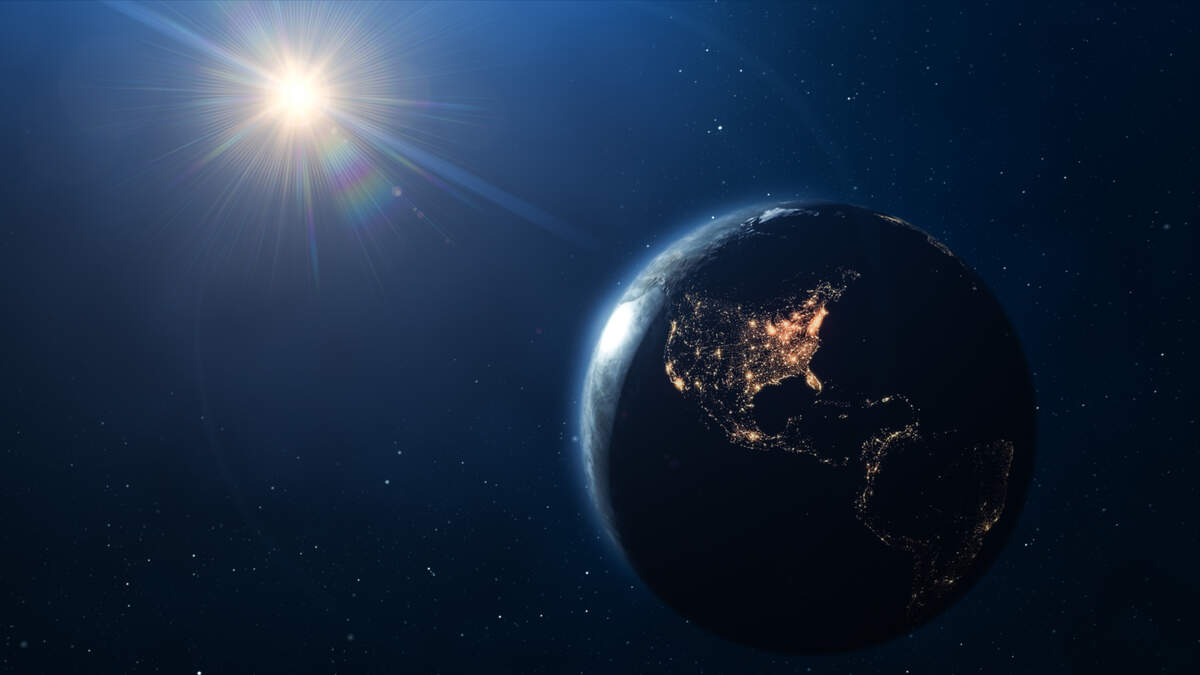

A Los Angeles County startup wants to put giant mirrors in space to reflect sunlight down to Earth at night — and sell that light to paying customers. The idea has triggered sharp pushback from scientists, astronomers, and health experts who say the plan could cause serious harm to the environment, human health, and the night sky.
Reflect Orbital, founded in 2021, is waiting for the U.S. Federal Communications Commission (FCC) to approve its first test satellite, called EARENDIL-1. According to SFGATE, a public comment period on the application closed on March 10. If the FCC gives the green light, the company could launch the test satellite as early as this summer.
The prototype would carry a mirror about 60 feet wide — roughly the size of a tennis court. That mirror could light up a circle on Earth’s surface up to three miles across. From the ground, the brightness inside that circle would be up to four times stronger than a full moon, the company says. An hour of that light would cost customers a minimum of $5,000.
Reflect Orbital founder and CEO Ben Nowack told SFGATE he sees the project as a way to unlock the sun’s power around the clock. “The sun powers 99% of life on Earth,” Nowack said. “It grows all the plants. We use a ton of sunlight in solar power, but we can’t use it at night. So I’m really excited to bring solar energy to nighttime.”
Nowack said the system is designed to be precise and controllable. “When a customer requests sunlight, we can rotate the satellite, light up that spot and provide that service,” he said, adding that the satellites are “nominally off” when not in use.
The company envisions customers including solar farms, agricultural operations, industrial worksites, city streets, defense operations, and even public events. By 2029, Reflect Orbital aims to have 1,000 satellites in orbit. By 2035, it hopes to have 50,000.
Not everyone is impressed.
DarkSky International CEO Ruskin Hartley called the project “an unprecedented assault on the nighttime environment.” Speaking to SFGATE, Hartley said, “Everything we know about the impact of light at night shows that it has a tremendous impact on ecology, on wildlife, plants, animals, fish, and, of course, on humans as well.”
Hartley also raised a regulatory concern: the FCC typically treats satellites in space as exempt from the National Environmental Policy Act, meaning regulators may not fully weigh the project’s environmental effects before granting approval.
Joanna Fong-Isariyawongse, a neurologist at the University of Pittsburgh who studies sleep and circadian rhythms, warned of serious health consequences. “This sounds appealing, but in reality, it comes at a real cost to our health,” she wrote in an email to SFGATE. She compared it to daylight saving time, noting, “We have spent decades documenting the cardiovascular, metabolic, and cognitive harms that follow even a one-hour clock shift each spring.”
Jamie Zeitzer, Ph.D., a Stanford University professor of psychiatry and behavioral sciences who has studied daylight saving time, warned that the ripple effects could travel far up the food chain. “Insects and plants can be very sensitive to such light and it could be extraordinarily disruptive to the food webs on the planet,” he wrote. “From a biology perspective, this seems like a truly terrible idea.”
Astronomers speaking to Live Science were equally alarmed. Samantha Lawler, an astronomer at the University of Regina in Canada, called the overall concept “a terrible idea” and put the stakes in stark terms: “One tiny company in California can, with a few million dollars and the approval of a single U.S. federal agency, change the night sky for everyone in the world. It’s horrifying.”
Robert Massey, deputy executive director of the U.K.’s Royal Astronomical Society, told Space.com the astronomy community is “seriously concerned about the development, its impact and the precedent it sets.” He added, “The central goal of this project is to light up the sky and extend daylight, and obviously, from an astronomical perspective, that’s pretty catastrophic.”
Experts also warn that the plan faces steep technical hurdles. Fionagh Thomson, a space ethics researcher at Durham University in England, called the plan “flawed from the outset, technically speaking,” pointing to the difficulty of engineering such a system in the crowded low Earth orbit (LEO) environment. Russia attempted similar reflector satellites in 1993 and 1999 — both burned up in the atmosphere after engineers lost control of them.
Some scientists also doubt the mirrors could actually power solar farms, as Reflect Orbital claims. A mirror could illuminate the same spot for a maximum of only four minutes at a time, and the reflected light would be thousands of times weaker than direct sunlight — generating only a small fraction of normal solar energy.
Reflect Orbital says its design includes safety measures, such as the ability to avoid research observatories and protected habitats. The company has also committed to conducting an environmental risk assessment — but only after EARENDIL-1 is already in orbit.
The FCC is currently deliberating on whether to approve the test satellite. No timeline has been set for a final decision.
Recent Comments