
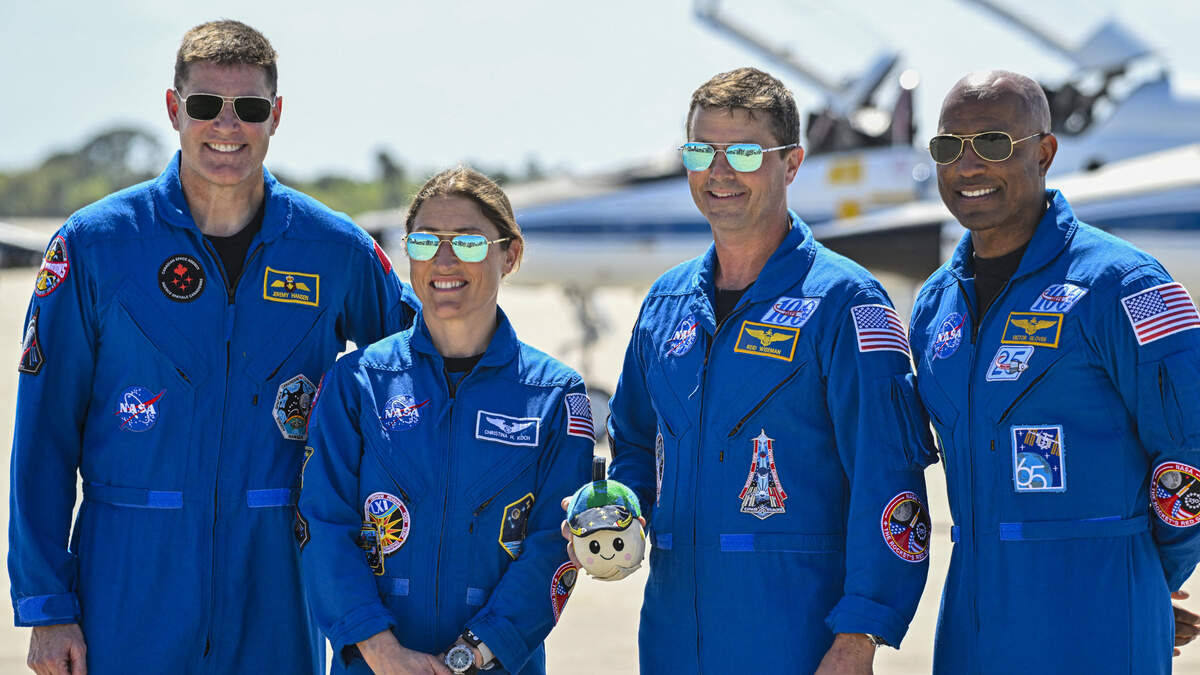

Four astronauts have launched into space as part of NASA’s Artemis II mission on Wednesday (April 1), marking the first time humans have traveled to the vicinity of the moon in more than 50 years.
The crew includes NASA astronauts Reid Wiseman, Victor Glover, and Christina Koch, along with Canadian Space Agency astronaut Jeremy Hansen. The mission will send the crew on a loop around the moon and back, potentially breaking the distance record set during the Apollo program, traveling farther from Earth than any human ever has. During the journey, Koch and Glover will make history as the first woman and first person of color, respectively, to venture into deep space.
Koch reflected on the significance of her role, noting that the mission’s historic milestones carry weight for future generations. “I am so grateful to those that paved the way for me to be here — and it’s an honor to potentially inspire the explorers of the future,” she said. Glover added that he hopes such “firsts” one day become unnecessary: “It’s about human history. It’s the story of humanity, not black history, not women’s history, but that it becomes human history.”
Before boarding the rocket, the crew followed a longstanding NASA tradition by signing their names on the wall of the “White Room”,” the small room at the end of the aerial walkway used to access the spacecraft. The astronauts were seen playing a card game beforehand to relax before the high-stakes launch.
Charlie Blackwell-Thompson, NASA’s first female launch director, is overseeing today’s liftoff from Firing Room 1 at Kennedy Space Center. She previously directed the successful launch of Artemis I, an uncrewed mission, in November 2022. True to her tradition, Blackwell-Thompson arrived Wednesday wearing a green blazer, part of her personal “green for go” ritual.
If the mission proceeds as planned, Artemis II will serve as a critical data-gathering step toward NASA’s long-term goal of sending astronauts to Mars. The Orion spacecraft will test its heat shield at speeds of roughly 24,600 miles per hour upon reentry, far faster than trips to low-Earth orbit. Medical teams will also monitor how the crew responds to deep-space radiation levels.
NASA Administrator Jared Isaacman has outlined an ambitious post-Artemis II roadmap that includes a new test mission next year, a moon base with monthly robotic landers, drones, and astronaut buggies.
Recent Comments