
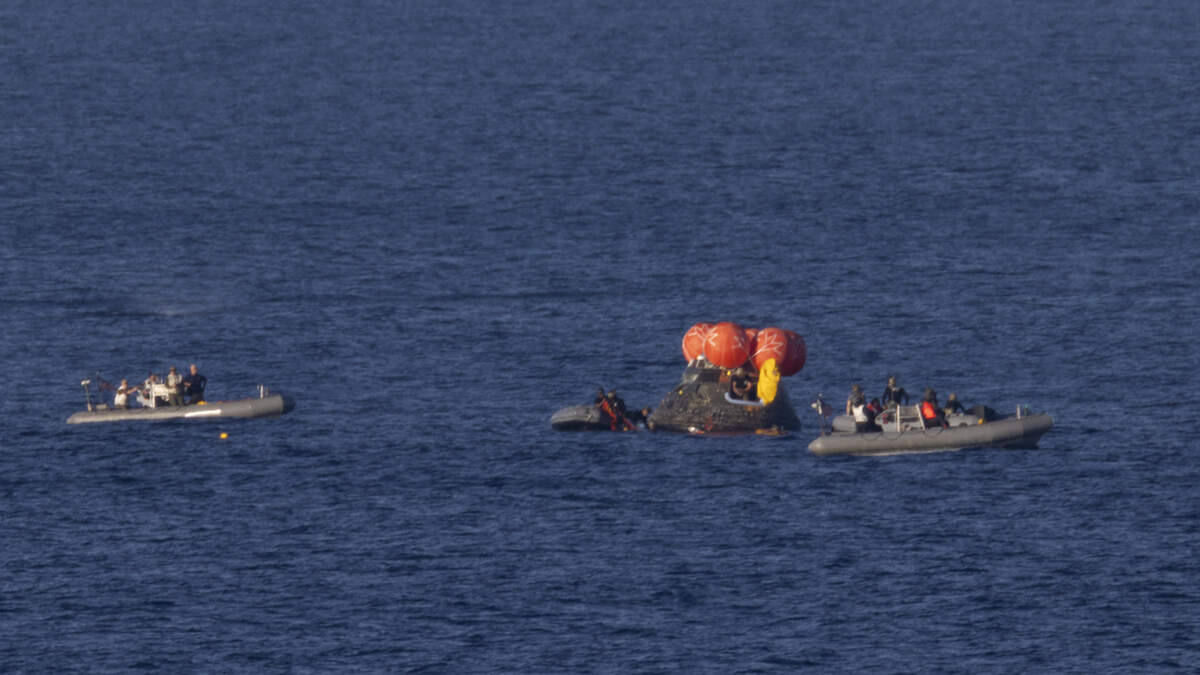

LOS ANGELES (CNS) – NASA’s Artemis II mission, piloted by a Southern California native, made a triumphant return to Earth Friday, splashing down off the coast of San Diego after traveling around the far side of the moon and farther from Earth than any humans in history.
The four astronauts splashed into the Pacific Ocean at 5:07 p.m.
The mission surpassed the previous distance record set by Apollo 13 in 1970 by traveling 248,655 miles from Earth during its lunar flyby Monday, according to NASA.
The roughly six-hour lunar loop marked a key milestone in NASA’s first crewed mission to the moon since the Apollo era, sending three Americans and one Canadian around the moon as part of plans to land astronauts near the lunar south pole within the next two years.
Among the astronauts aboard was Victor Glover, a Southern California native who was born in Pomona, attended Ontario High School and graduated from Cal Poly San Luis Obispo. Serving as pilot of the Orion spacecraft, he was the first person of color to take part in a lunar mission.
Glover was joined by Commander Reid Wiseman and mission specialists Christina Hammock Koch and Jeremy Hansen.
Gov. Gavin Newsom was among those who celebrated the return of the Artemis II crew.
“Here in California, we’re proud to anchor the historic NASA Artemis II mission — and proud of our state’s role in making this mission a success,” Newson said.
“For the over 16,000 California workers, 500 companies, and three NASA centers who worked on the mission, the crew splashing down off the California Coast is a full-circle moment and point of immense pride. Artemis II is a unifying moment for all of us here on Earth that we can shoot for the stars and strive for a brighter future, for all.”
Four Navy sailors with San Diego-based Explosive Ordnance Disposal Group ONE were the first to make contact with the Artemis II crew.
The sailors made up a dive medical team who made initial medical assessments of the astronauts within the Orion capsule, known as “Integrity.”
All four crewmembers were reported by NASA to be in good condition shortly after arrival.
Navy divers and other recovery personnel erected an inflatable raft dubbed the “Front Porch,” on which the astronauts made their first steps outside of the capsule.
The crewmembers exited Integrity at around 6:30 p.m.
The astronauts were then flown out of the water by Navy helicopters to the San Diego-based U.S. Navy amphibious transport dock USS John P. Murtha for additional medical exams.
In a statement Monday, the Navy said the ship has “unique advantages” that will assist NASA in the Orion space capsule’s recovery and collection of “critical data to help ensure it’s ready to recover the astronauts and capsule during future Artemis missions.”
The ship’s commanding officer, Capt. Erik Kenny, said the ship’s mission this week was “a fitting tribute” to its namesake, the late Rep. John P. Murtha, D-Pennsylvania..
“We are honored to carry on his legacy by supporting NASA and the Artemis II mission,” Kenny said.
Ahead of the mission’s return, attention was focused on the spacecraft’s thermal protection system, designed to endure extreme temperatures during its descent through the atmosphere. During an uncrewed test flight in 2022, the exterior surface showed widespread scorching and damage upon return.
NASA officials said the astronauts were re-entering Earth’s atmosphere at about 32 times the speed of sound, reaching velocities comparable to those achieved during NASA’s Apollo-era lunar missions.
A U.S. Navy helicopter squadron based out of Naval Air Station North Island assisted in tracking the capsule while it traveled through Earth’s atmosphere and in recovering the four astronauts.
Navy divers were also deployed to recover and transport the Orion space capsule from the water to the ship’s deck.
NASA used cameras mounted on the spacecraft this week to examine its exterior for any signs of damage or irregularities that could threaten the astronauts’ safety ahead of Friday’s return. Re-entry is one of the most demanding phases of a mission, as spacecraft are subjected to extreme heat and pressure while passing through Earth’s atmosphere.
The inspection found the spacecraft to be in good condition, according to Debbie Korth, deputy manager of the Orion program.
The Artemis II crew drew widespread attention on Earth through broadcasts and news conferences from inside their capsule, which offered roughly the same living space as two minivans.
Asked Wednesday what she would miss most about the mission, Koch pointed to the bond among the crew and with colleagues on the ground.
“We are close like brothers and sisters, and that is a privilege we will never have again,” she said.
On Thursday, the crew began preparing the cabin for re-entry and reviewing entry procedures.
During the crew’s flyby of the moon, Artemis II astronauts photographed the lunar surface and recorded observations while losing contact with mission control for about 40 minutes as the capsule passed behind the moon.
As they emerged from the far side, the crew joined a small group of humans who have witnessed an “Earthrise.”
Glover previously spent more than five months aboard the International Space Station in 2020-21, traveling there on the first full crew rotation flight by a U.S. commercial spacecraft.
He also has extensive ties to Southern California beyond his upbringing, having served as a test pilot at Naval Air Weapons Station China Lake in the Mojave Desert and earning a master’s degree from Air University at Edwards Air Force Base.
Communications for the mission were handled in part by NASA’s Deep Space Network, managed by the Jet Propulsion Laboratory near Pasadena.
The current schedule calls for the Artemis III launch sometime next year, with lunar landers under development by Hawthorne-based SpaceX and Jeff Bezos’ Blue Origin.
Artemis IV is expected to launch in early 2028, marking a return of astronauts to the lunar surface.
Artemis V, another lunar surface mission, is projected for late 2028, with additional missions planned roughly once a year after that.
Recent Comments