
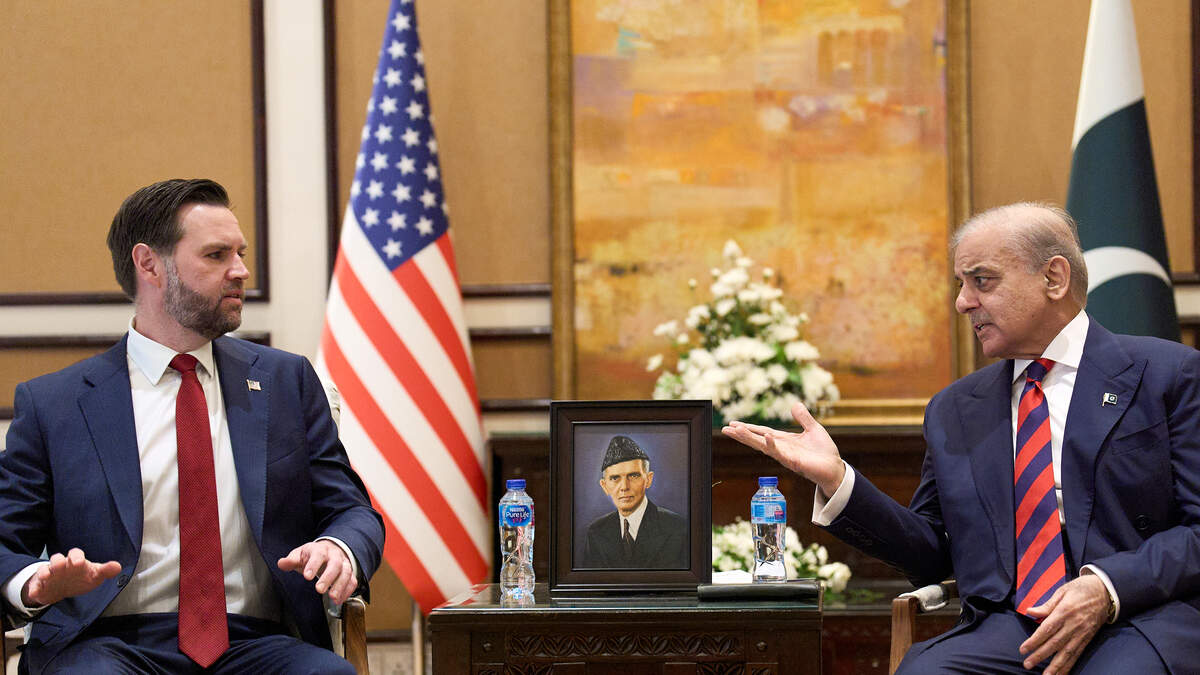

High-level peace talks between the United States and Iran began in Islamabad, Pakistan on Saturday (April 11), marking a rare direct negotiation between the longtime adversaries as regional tensions remain high. The discussions, mediated by Pakistan, come as fighting continues in Lebanon and the Strait of Hormuz remains largely closed, disrupting the global oil market.
The US delegation is led by Vice President JD Vance, who is joined by special envoy Steve Witkoff and adviser Jared Kushner. Iran’s team is headed by parliament speaker Mohammad Bagher Ghalibaf and foreign minister Abbas Araghchi. Both delegations met separately with Pakistan’s Prime Minister Shehbaz Sharif, who expressed hope that the talks could be a “stepping stone toward durable peace in the region.”
Security in Islamabad is extremely tight, with the city’s diplomatic district cordoned off and international media stationed at the convention center where the talks are taking place. Musicians played in front of banners reading “Islamabad talks,” reflecting the high stakes and global attention on the negotiations.
The talks follow a conditional two-week ceasefire between the US and Iran, but both sides have shown deep mistrust. Iran’s parliament speaker said, “We have goodwill, but we do not have trust,” referencing past failed negotiations and recent US military strikes during talks. He also insisted that Iran’s conditions—such as a ceasefire in Lebanon and the release of frozen assets—still need to be met before true progress can be made.
President Donald Trump, who authorized the US delegation, has claimed the US military has cleared Iranian sea mines from the Strait of Hormuz and that “the strait will be open in the not-too-distant future.” Trump also said on social media that Iran’s navy and air force have been destroyed and that empty oil tankers are heading to the US to load American oil, though experts note the US uses most of its oil domestically and some of these claims are exaggerated.
Vice President Vance told reporters before departing for Pakistan that he expected “positive” results from the talks if Iran negotiates “in good faith,” but warned that attempts to “play” the US would not be tolerated.
Despite the diplomatic effort, violence continues in the region. Israeli airstrikes in southern Lebanon killed and wounded several people, and Hezbollah has vowed to keep fighting until what it calls “Israeli-American aggression” ends. The fate of Lebanon is one of many unresolved issues, with Iran demanding its inclusion in the current ceasefire, while the US and Israel maintain that Lebanon is not covered by the agreement.
Recent Comments