
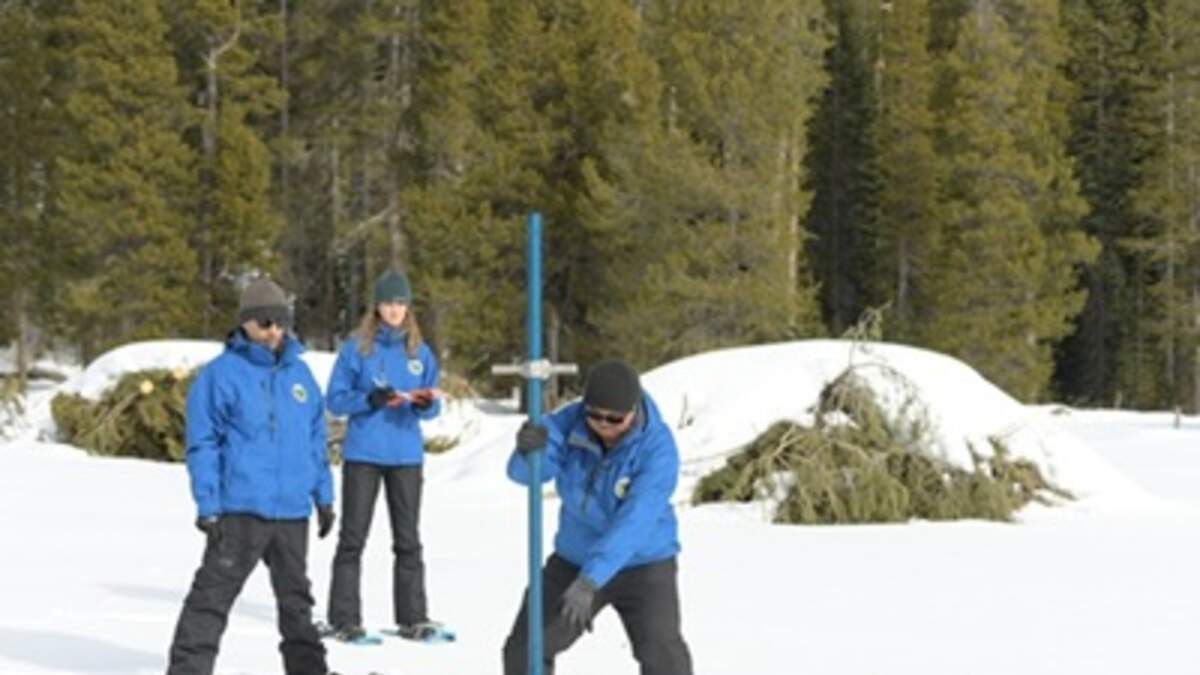

California’s Sierra Nevada snowpack reached a historic low on Wednesday, with state surveyors recording zero measurable snow at the Phillips Station monitoring site near Lake Tahoe. The statewide snowpack now sits at just 18 percent of average, marking the second lowest April measurement on record.
Andy Reising, manager of snow surveys for the California Department of Water Resources, announced the startling results at the monthly survey. “Today, our survey recorded zero inches of water content and zero inches of depth, which puts us at 0% of average for this particular location,” he said during Wednesday’s survey.
The rapid snowpack disappearance stems from record-shattering heat in March combined with high-elevation rain that melted away the already below-average winter accumulation. Daniel Swain, a climate scientist with UC Agriculture and Natural Resources, described the March warmth as one of the most “extreme heat events ever observed in the American Southwest,” according to the Los Angeles Times.
Historically, April marks when the Sierra snowpack reaches its peak volume before gradually melting through summer months to feed California’s rivers and reservoirs. This year, however, the snowpack peaked on February 25 at just 73 percent of average, then rapidly declined. “The snow melt that we saw in March looked more like we would typically see in later April or even May,” Reising explained.
The only lower April reading occurred in 2015, when the Phillips Station also recorded zero snow. That year’s statewide snowpack measured just five percent of average.
Despite the minimal snowpack, major reservoirs in Northern California remain nearly full thanks to decent rainfall this winter and three consecutive wet years. Karla Nemeth, director of the Department of Water Resources, emphasized the significance of existing water stores. “What we have in our reservoirs in California is all we’re going to get,” she said, urging Californians to use water carefully.
The premature melt raises concerns beyond immediate water supply. Peter Gleick, co-founder of the Pacific Institute, warned that forests will dry out a month or more earlier than usual. “It could be a very bad fire year,” he said. “It also means rivers and streams are going to dry out sooner, and that has bad implications for natural ecosystems and our fisheries.”
Climate scientists say the early snowmelt reflects long-term patterns intensifying with rising temperatures. “This particular year is as clear an indication of the influence of climate change as anything we’ve seen,” Gleick told reporters. “Climate change is influencing California’s water system quickly and severely.”
The Department of Water Resources expanded monitoring efforts this year, conducting 100 additional mid-month snow surveys across 18 critical watersheds to better track the rapid melt.
Some additional snow arrived in the Sierra Nevada this week, falling lightly as state water managers held their survey on the bare meadow. However, officials say it will not compensate for the massive snowmelt that already occurred.
California traditionally relies on Sierra snowpack to store approximately 30 percent of its water needs. The snowpack’s natural storage capacity has earned it the nickname of California’s “frozen reservoir.” Water managers use data from the April snow surveys to calculate how much snowmelt runoff will flow into rivers and reservoirs, informing critical decisions about flood control and water supply allocation.
Nemeth stressed that the minimal snow and high temperatures “are setting us up for what will be a challenging year for water management in the state.” She emphasized the need for significant investment in water recycling and more efficient water use as California adapts to volatile precipitation patterns and shorter wet seasons.
Recent Comments