
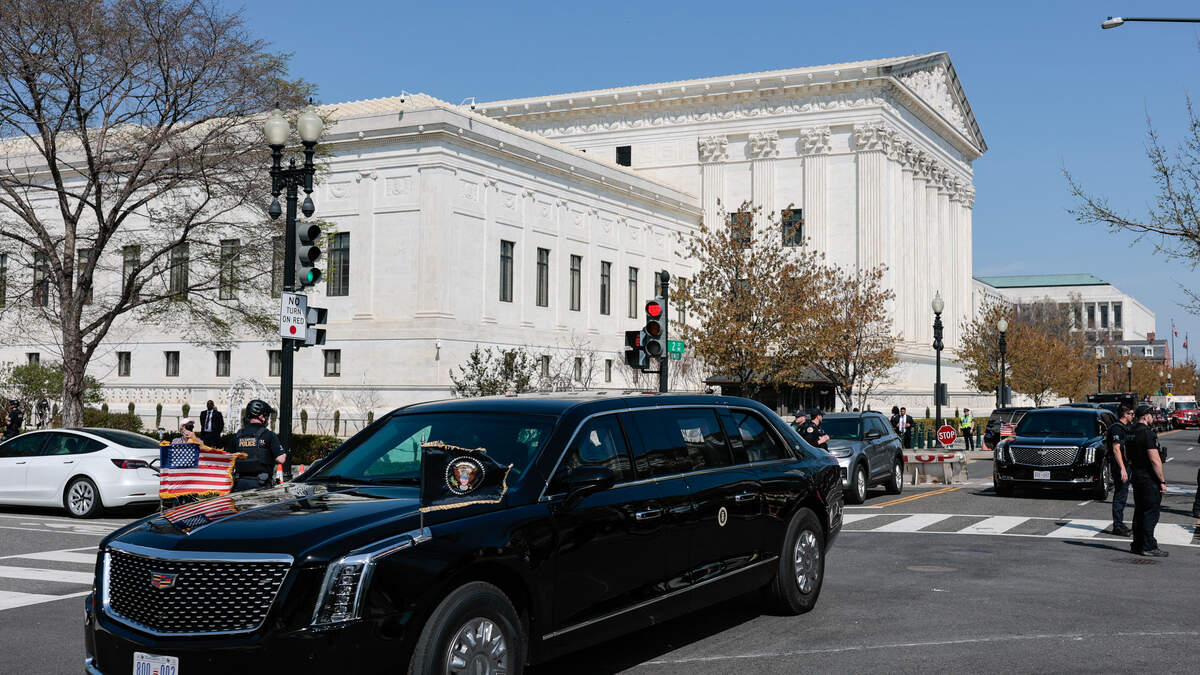

President Donald Trump delivered his first public reaction Wednesday (April 1) after personally attending oral arguments at the U.S. Supreme Court in a landmark case that could reshape American citizenship law for generations.
“We are the only Country in the World STUPID enough to allow “Birthright” Citizenship,” Trump wrote on Truth Social.
The Supreme Court heard arguments in Trump v. Barbara, a case that directly challenges President Trump’s January 2025 executive order seeking to end automatic birthright citizenship for babies born in the United States to parents who are in the country illegally or on a temporary visa. Sources in the courtroom told Fox News the president arrived roughly 10 minutes before arguments began and remained focused throughout, staying for the entirety of Solicitor General D. John Sauer‘s argument, which ran 65 minutes.
The case centers on the 14th Amendment’s Citizenship Clause, which reads: “All persons born or naturalized in the United States, and subject to the jurisdiction thereof, are citizens of the United States.” President Trump signed Executive Order No. 14,160, titled Protecting the Meaning and Value of American Citizenship, on his first day back in office in January 2025. The order has never taken effect, blocked repeatedly by federal courts that ruled it likely unconstitutional.
As SCOTUSblog explains, every lower court that has weighed in on the order has ruled against it. In July 2025, U.S. District Judge Joseph LaPlante in New Hampshire certified a nationwide class action and issued an injunction protecting children born to undocumented parents, concluding the order “likely contradicts the text of the Fourteenth Amendment and the century-old untouched precedent that interprets it.”
The administration’s core legal argument is that the Citizenship Clause was written specifically to grant citizenship to formerly enslaved people and their descendants, and not to the children of people who are in the country illegally or only temporarily. Sauer argues that to qualify for birthright citizenship, a child must be born to parents who are “domiciled” in the United States, meaning they have established a permanent home here and owe direct allegiance to the country.
Opponents of the executive order, led by the American Civil Liberties Union (ACLU), argue the administration’s reading would overturn more than a century of settled law. According to the National Constitution Center, the challengers point to the Supreme Court’s landmark 1898 ruling in United States v. Wong Kim Ark, which held that a child born in San Francisco to Chinese immigrant parents was automatically a U.S. citizen. The ACLU argues that ruling established citizenship by birth as the rule regardless of a parent’s immigration status or how long they had lived in the country.
Both sides also disagree on what the statute codifying the Citizenship Clause, 8 U.S.C. § 1401, requires. The challengers say Congress, when it passed and later re-enacted the law, understood birthright citizenship to apply broadly. The administration says courts should focus on what the language actually means today, not what lawmakers thought it meant decades ago.
A ruling in Trump v. Barbara is expected by late June or early July, and it is widely expected to be one of the most consequential decisions the Supreme Court has issued in years.
Recent Comments