
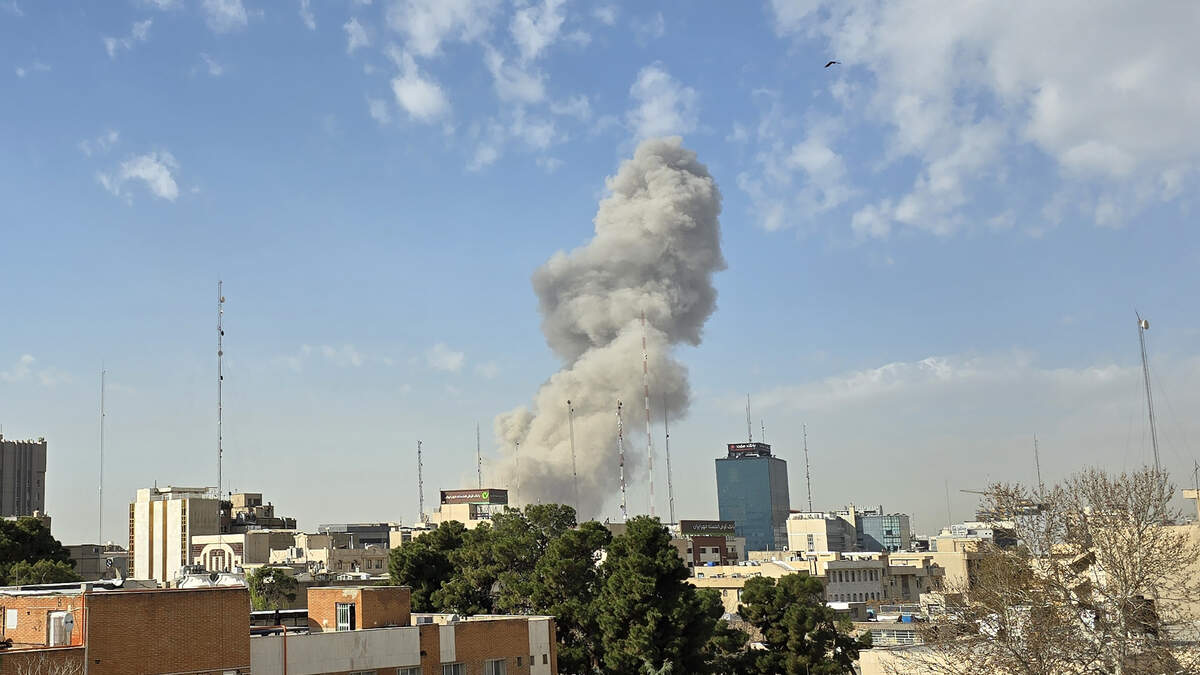

The United States and Israel launched major combat operations against Iran on Saturday (February 28), triggering a wave of retaliatory missile strikes from Tehran that targeted American military bases and civilian areas across the Middle East.
President Donald Trump confirmed the offensive — dubbed “Operation Epic Fury” by the Pentagon — in a video posted to Truth Social, saying the goal was to “defend the American people by eliminating imminent threats from the Iranian regime.” According to The Washington Post, Trump told the outlet in a phone call that his main concern was “freedom” for the Iranian people, adding, “I want a safe nation, and that’s what we’re going to have.”
The attack is a complex, multi-domain operation involving the U.S. Space Force, Marines, Army, Navy, and Air Force, and includes sea-launched Tomahawk missiles and air-launched weapons fired from U.S. Air Force and Navy jets. Two U.S. officials told NBC News that the military action is expected to last several days.
Israeli Prime Minister Benjamin Netanyahu called the joint strike a move to “remove the existential threat posed by the terrorist regime,” and said the operation would continue “as long as needed.” Israeli Defense Minister Israel Katz declared a special state of emergency across all of Israel.
Iran’s internet was nearly completely cut off as the strikes began, with the London-based monitoring group NetBlocks reporting national connectivity had dropped to just 4% of normal levels — a pattern similar to the blackout imposed during widespread street protests in January.
Explosions were reported across Tehran and other Iranian cities, including Qom, Lorestan, Kermanshah, Karaj, and Tabriz. Al Jazeera reported that its correspondent on the ground saw smoke rising across the city. One of the areas struck was near the offices of Supreme Leader Ayatollah Ali Khamenei, who, according to a Reuters source, was not in Tehran and had been moved to a secure location. According to The Washington Post, Khamenei and other senior Iranian officials were also among the targets.
An Israeli strike hit an elementary school in Minab, a city in southern Iran’s Hormozgan province, killing at least 40 people, according to Iran’s state-run IRNA news agency.
Iran’s Islamic Revolutionary Guard Corps (IRGC) announced it had launched a “first broad wave of missile and drone attacks” toward Israel in response. Explosions were reported in northern Israel as the Israeli military worked to intercept the incoming fire. Iran’s Supreme National Security Council vowed a “crushing response,” saying, “The armed forces of the Islamic Republic of Iran have begun a crushing response to their malicious actions.”
Iranian missiles also struck or targeted U.S. military bases across the Gulf region, including Al Udeid Air Base in Qatar, Al Salem Base in Kuwait, Al Dhafra Air Base in the United Arab Emirates (UAE), and the U.S. Navy’s Fifth Fleet headquarters in Bahrain. The UAE confirmed that one person was killed in Abu Dhabi after debris from an intercepted missile fell on a residential area. As of early Saturday, no American casualties had been reported, though two U.S. officials cautioned the situation remained fluid.
Saudi Arabia condemned what it called “brutal Iranian aggression,” expressing “full solidarity” with affected neighboring countries. Kuwait invoked Article 51 of the United Nations (UN) Charter, asserting its “full and legitimate right to defend itself.” Qatar’s transportation ministry urged all maritime vessels to temporarily suspend navigation as a precautionary measure.
Russia condemned the strikes as an “unprovoked act of armed aggression against a sovereign state,” saying the scale of preparations left “no doubt” the attack was pre-planned.
This marks the second U.S. military strike on Iran in under a year. In June 2025, the U.S. dropped “bunker buster” bombs on Iranian nuclear facilities during what Trump called “Operation Midnight Hammer.” At the time, Trump said Iran’s nuclear sites were “completely and fully obliterated,” though experts said the sites were damaged but not destroyed.
Trump also called directly on the Iranian people to “take over your government,” signaling that regime change is among the operation’s goals. Netanyahu echoed that message, saying the joint action would “create the conditions for the courageous Iranian people to take their destiny into their own hands.” Reza Pahlavi, the U.S.-based son of Iran’s deposed shah, urged Iranians to prepare to return to the streets, calling it a moment of “final victory” — but told them to wait for his signal.
Defense Secretary Pete Hegseth and President Trump are both expected to provide updates on the operation as it continues. U.S. officials say they expect Iran to keep retaliating, and the strikes on Iran are set to continue through at least the weekend.
Recent Comments