
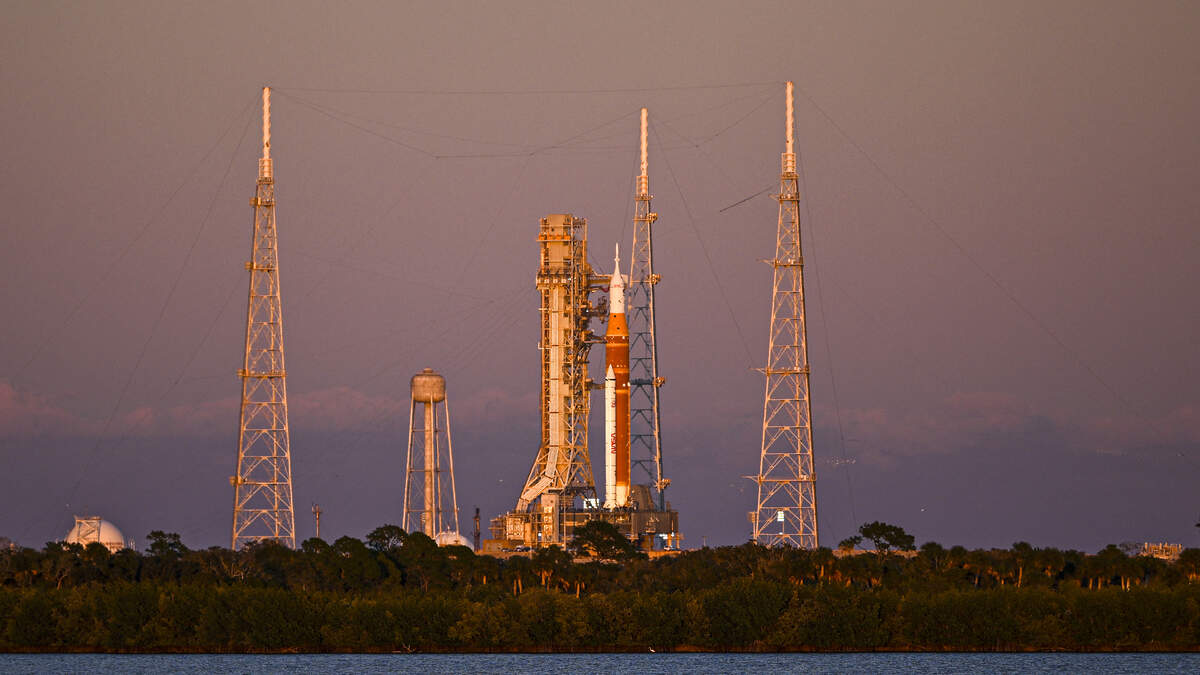

NASA’s Artemis II moon rocket is heading back to its hangar at Florida’s Kennedy Space Center after engineers discovered a problem with the rocket’s helium pressurization system — a setback that pushes the first crewed lunar mission in decades back by at least a month.
Artemis 2 Launch Director issued the “go” order at 9:38 a.m. ET, with first motion confirmed about 10 minutes later. The 322-foot-tall Space Launch System (SLS) rocket — stacked with the Orion capsule on top and weighing a combined 11 million pounds — began its slow, roughly 12-hour journey from Launch Complex 39B back to the Vehicle Assembly Building (VAB), traveling at about one mile per hour aboard a massive crawler-transporter vehicle.
The Artemis II mission had been targeted for a March 6 launch, which would have sent four astronauts — NASA’s Reid Wiseman, Victor Glover, and Christina Koch, and Canadian Space Agency astronaut Jeremy Hansen — on a 10-day flight around the moon. That launch is now off the table. NASA is eyeing April as the next possible launch window, with opportunities on April 1, April 3 through April 6, and April 30, though the exact date will depend on the outcome of repairs.
The helium issue was first detected on February 19, just after what had appeared to be a successful wet dress rehearsal — a test that loads the rocket with more than 700,000 gallons of cryogenic propellant and simulates almost every step of a launch countdown. The helium pressurization system malfunction came after the rocket had already been delayed a month by hydrogen fuel leaks detected during an earlier fueling test on Sunday (February 2).
Once back inside the VAB’s High Bay 3, technicians will lower platforms to gain access to the rocket’s Interim Cryogenic Propulsion Stage (ICPS) — the upper stage where the helium flow issue was found. Engineers will also replace and retest batteries in both the upper stage and the rocket’s flight termination system while the vehicle is in the hangar.
NASA Administrator Jared Isaacman acknowledged the frustration felt by many following the delay. “I understand people are disappointed by this development,” Isaacman wrote on X. “That disappointment is felt most by the team at NASA, who have been working tirelessly to prepare for this great endeavor.”
With the launch delay freeing the crew from pre-launch quarantine, all four Artemis II astronauts attended President Trump’s State of the Union address at the U.S. Capitol on Tuesday (February 24) as invited guests of House Speaker Mike Johnson (R-Louisiana). Johnson’s home state is where much of the SLS rocket is manufactured at NASA’s Michoud Assembly Facility in New Orleans. “It is my privilege to welcome these brave and courageous astronauts as my guests at the State of the Union Address,” Johnson said in a statement.
The Artemis II mission will be the first time NASA’s SLS rocket and Orion capsule have carried people to the vicinity of the moon. A previous uncrewed Artemis I flight around the moon in 2022 also faced delays of roughly six months — largely due to hydrogen leaks discovered during its own wet dress rehearsal.
Recent Comments