
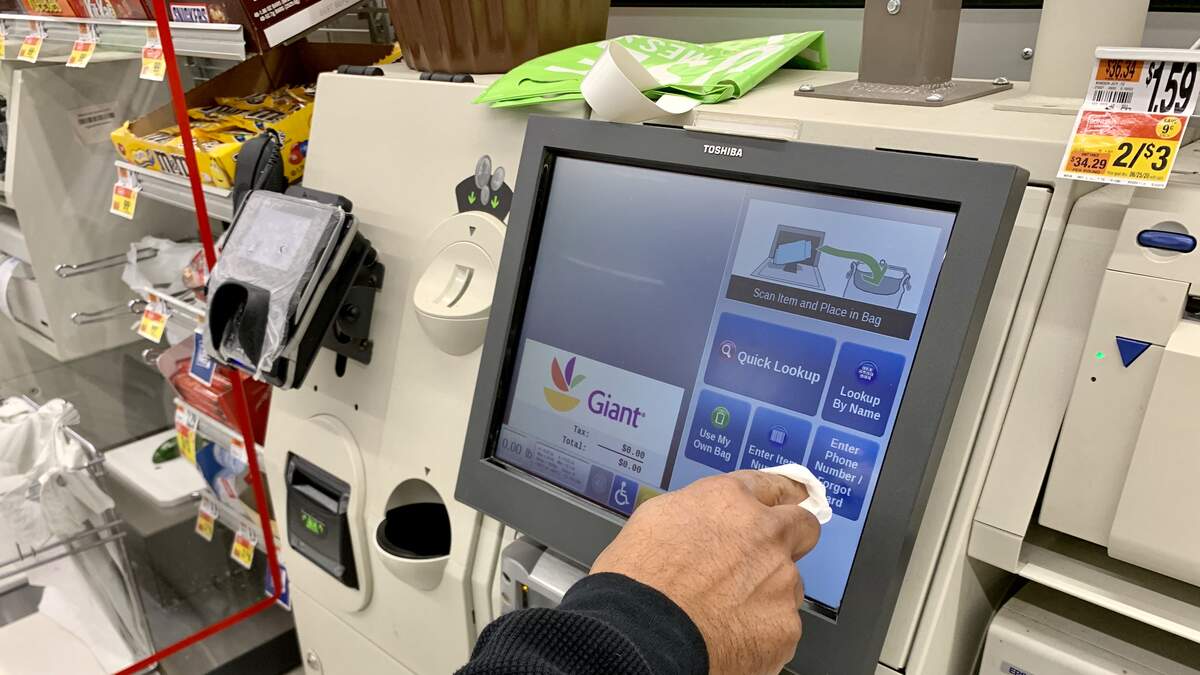

Costa Mesa has become the second city in California to regulate self-checkout lanes, passing a new ordinance that limits how many kiosks one employee can monitor and caps the number of items shoppers can ring up on their own. Long Beach, passed a similar first-of-its-kind law last August, making it the first California city to regulate self-checkout
The Costa Mesa City Council voted 5-2 on Tuesday to approve the “Safe Stores are Staffed Stores” ordinance, which takes effect on April 18. According to the Orange County Register, the new rules apply to grocery stores larger than 15,000 square feet and all retail drug establishments with self-checkout stations, affecting nearly two dozen businesses in the city.
Under the ordinance, one dedicated employee must oversee no more than three self-checkout machines at a time. Shoppers are limited to 15 items or fewer at those stations, and no items stored in locked cases may be purchased through self-checkout. A staffed checkout lane must also be open before any self-checkout kiosks can be used.
Businesses that violate the rules will have 15 days to fix the problem before facing fines of $100 per day for each unstaffed attendant position, up to a maximum of $1,000 per day.
The Los Angeles Times reported that supporters of the measure included members of the United Food & Commercial Workers International Union (UFCW), who described being stretched dangerously thin while monitoring as many as eight self-checkout stations simultaneously.
One Vons employee who identified herself as Maria told the council at a January meeting what that workload looks like in practice. “That’s 13 things I have to do at one time by myself, and if a customer needs something I have to stop and help them,” she said. “I hope you consider what we’re asking for. It would make for a more pleasurable experience for everyone.”
Matt Walters, a produce manager at Pavilions, echoed those concerns. In a statement released by UFCW Local 324, Walters said, “Stores push customers towards self-checkout instead of the manual cashier line, and the person in charge of the self-checkout area has to supervise multiple machines while still performing other duties. This is unsustainable and ultimately leads to increased theft.”
Councilmember Loren Gameros, one of five council members who voted in favor, pushed back on arguments that the ordinance would harm business. “My concern here is not that we’re trying to ruin business,” Gameros said. “It’s that we’re not thinking of those who actually are working families that work for a living that are being held responsible for the safety and theft at a grocery store.”
Not everyone on the dais agreed. Councilmember Jeff Pettis, who voted against the measure, said he spoke informally with Long Beach grocery store owners and shoppers, and found that 90% of them disliked that city’s similar law. He said some Long Beach stores had already closed self-checkout kiosks rather than hire additional staff, and warned that Costa Mesa shoppers might take their business, and their sales tax dollars, elsewhere.
Councilmember Mike Buley, who also voted no, called the ordinance “a solution in search of a problem,” and said it sent the wrong message to the business community.
Mayor john Stephens, who voted in favor, acknowledged those concerns but noted the city has built in safeguards. “If the issue happens and people hate this in Costa Mesa, we have two failsafes,” Stephens said. “We will look at it in one year. And also, anybody who votes for this tonight, and I will be voting for it, can bring it back for reconsideration.”
Recent Comments