
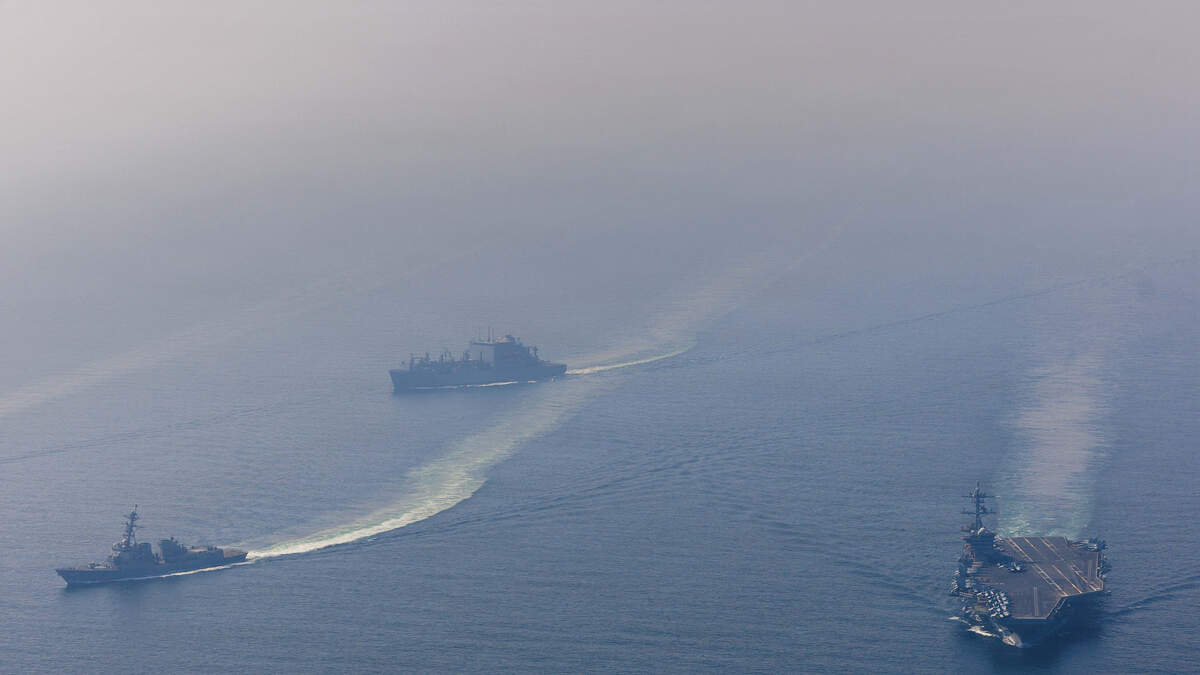

The United States military is positioning an extensive array of weaponry in the Middle East as President Donald Trump weighs possible military action against Iran, according to reports from multiple defense officials. The deployment includes two aircraft carriers, fighter jets, refueling tankers, destroyers, and submarines, creating the largest U.S. military buildup in the region since the 2003 invasion of Iraq.
The Defense Department has sent additional warships, air defenses, and submarines to prepare for potential strikes, though President Trump has not yet made a final decision on whether to authorize military action. Officials familiar with the matter told CNN that the military could be ready for an attack as early as this weekend, though Trump has privately debated both for and against such action while consulting advisers and allies.
The USS Gerald R. Ford, the Navy’s most advanced aircraft carrier, is steaming across the Atlantic Ocean and expected to arrive in the Mediterranean Sea within days. The carrier and its strike group will join the USS Abraham Lincoln, which is already positioned in the Persian Gulf with its accompanying ships. Additional naval assets include at least three littoral combat ships, a guided missile destroyer in the Red Sea, and two guided missile destroyers near the Strait of Hormuz.
The military buildup occurs alongside ongoing diplomatic efforts between Washington and Tehran. Iranian Foreign Minister Abbas Araghchi noted “good progress” after indirect talks in Geneva on Tuesday with Steve Witkoff, Trump’s special envoy, and Jared Kushner, the president’s son-in-law. White House press secretary Karoline Leavitt acknowledged Wednesday that “there was some progress made” but emphasized “there are still a lot of details to discuss.”
Top administration national security officials met Wednesday in the White House Situation Room to discuss Iran, with officials indicating that all U.S. military forces required for possible action would be in place by mid-March. Trump appeared to set a 10-day deadline Thursday morning, telling an audience “you’re going to be finding out over the next probably 10 days” whether a deal materializes, warning that “bad things” would happen otherwise.
The Trump administration has demanded that Iran agree to restrictions on both its nuclear program and ballistic missile capabilities. Tehran has so far rejected any limitations on its missile program as out of the question. The two sides remain far apart on fundamental issues despite the diplomatic engagement.
Aircraft carriers and accompanying warships allow the U.S. to conduct operations without relying on bases in Arab Gulf states, whose governments have said they will not permit offensive operations from their territories due to fears of retaliation from Iran’s missile arsenal. The deployment dwarfs the military buildup Trump ordered off the coast of Venezuela before ousting President Nicolas Maduro.
It remains unclear whether any potential attack would involve U.S. forces alone or joint operations with Israel. Secretary of State Marco Rubio is scheduled to travel to Israel on February 28 to meet with Prime Minister Benjamin Netanyahu and provide an update on the Iran negotiations. Netanyahu, who visited Washington last week, has expressed concern about the status of the talks. Israel opposed the 2015 Iran nuclear deal, which Trump withdrew from during his first term.
If Trump decides to proceed with military action, potential targets could include Iran’s air defense systems, ballistic missile depots and launchers, drone manufacturing plants, and bases used by the Revolutionary Guards and Basij militia. The June strikes Trump ordered against three nuclear sites in Iran lasted less than 30 minutes. This time, an air attack could last longer if Trump seeks to inflict more extensive damage.
Iran has renewed construction work at Pickaxe Mountain, an underground nuclear site near Natanz that was not targeted in the June operation. New satellite imagery shows Iran is fortifying several nuclear facilities, using concrete and large amounts of soil to bury key sites.
The diplomatic window may be closing rapidly. Leavitt said Wednesday that Iran is expected to provide more details on its negotiating position “in the next couple of weeks,” but she would not say whether Trump would hold off on military action during that timeframe. “I’m not going to set deadlines on behalf of the president of the United States,” she said, adding that while “diplomacy is always his first option,” military action remains on the table.
Several calendar events could influence the timing of any potential strike. The Winter Olympics conclude Sunday, with some European officials believing no attack would occur before then. Ramadan, which began Wednesday, presents another consideration, as officials from U.S. allies in the Middle East have said an attack during the Muslim holy month would be perceived as disrespectful. Trump is scheduled to deliver his State of the Union address on Tuesday.
Recent Comments