
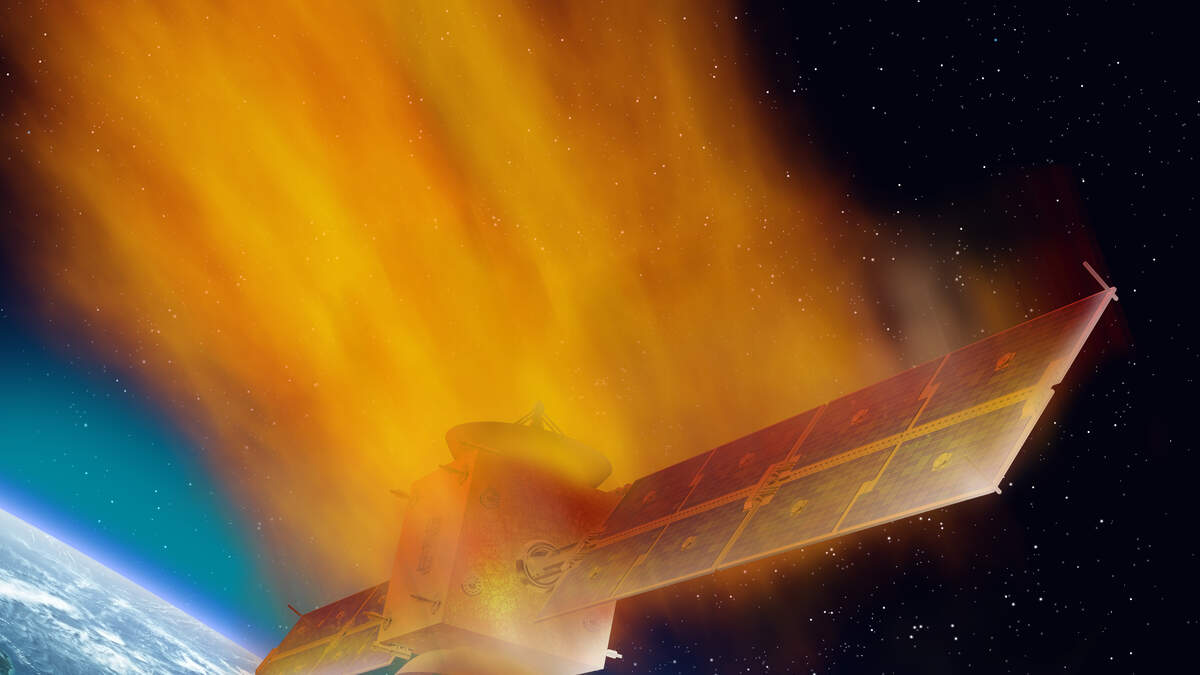

A 1,323-pound NASA satellite is expected to fall back to Earth tonight, Tuesday (March 10), after nearly 14 years in orbit — but space officials say the risk to people on the ground is very low.
The spacecraft, known as Van Allen Probe A, is predicted by the U.S. Space Force to re-enter Earth’s atmosphere at approximately 7:45 p.m. Eastern Time, with a window of uncertainty of plus or minus 24 hours.
“NASA expects most of the spacecraft to burn up as it travels through the atmosphere, but some components are expected to survive re-entry,” NASA officials said in a statement Monday (March 9). “The risk of harm coming to anyone on Earth is low — approximately 1 in 4,200.”
That roughly 0.02% chance of injury factors in the fact that water covers about 70% of Earth’s surface, making it far more likely that any surviving debris would splash down in the open ocean rather than over a populated area.
Van Allen Probe A launched in August 2012 alongside its twin, Van Allen Probe B, as part of a mission to study the Van Allen radiation belts, which are rings of charged particles held in place by Earth’s magnetic field. Those belts shield Earth from cosmic radiation, solar storms, and the solar wind that can harm both humans and technology.
The mission was originally designed to last just two years, but the twin probes kept operating until 2019, when they ran out of fuel and could no longer orient themselves toward the sun. NASA ended the mission at that point. The data they gathered, however, continues to inform science today.
“By reviewing archived data from the mission, scientists study the radiation belts surrounding Earth, which are key to predicting how solar activity impacts satellites, astronauts, and even systems on Earth such as communications, navigation, and power grids,” NASA officials said.
The probes were originally expected to remain in orbit until 2034. However, an unexpectedly active solar cycle, which peaked in 2024, caused Earth’s upper atmosphere to expand, increasing drag on the spacecraft and pulling it back toward Earth much sooner than predicted.
That same heightened solar activity has had a lesser effect on Van Allen Probe B, which is not expected to re-enter Earth’s atmosphere before 2030.
NASA and the Space Force will continue to monitor Van Allen Probe A’s descent throughout the day, and the projected re-entry time may be updated as new data becomes available.
Recent Comments